These are some photographs taken on a recent walk around part of the perimeter of the Olympic site in east London. The walk was part of a Constructing Sites workshop organised by Gesche Wuerfel at Goldsmiths University's
Centre for Urban and Community Research, with the photographers Tristan Fennell and David Kendall. It was a scorching 27 June, and what these photographs don't show is me getting horribly sunburned.

Hackney Wick.

Gate, and tower of unknown purpose.

A peek through the above gate. A distinct sense of post-zombie-apocalypse military checkpoint. That said, some of Hackney Wick looks like that all the time, only without the blue fencing. The blue fencing - immortalised by Iain Sinclair,
here - reminded me very strongly of the sky-painted
utopian housing in Terry Gilliam's
Brazil.
Brazil picture from
this magnificient site.

However, the fence is being taken down and replaced with a more straightforward electric fence, seen here behind an outer non-electric safety fence, which will weed out the less determined and stupid miscreants.

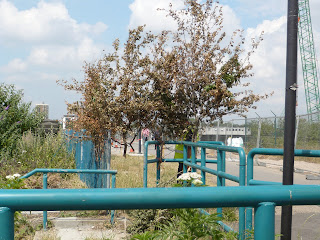
A small stretch of blue fence is still there, deviating around some trees in the sort of highly visible micro-courtesy that often serves as a shield for some obscured Godzilla incourtesy. Still, it's sort of charming.
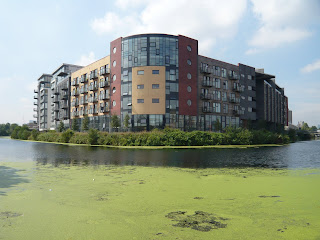
Regeneration, in all its glory. It was algae mardi gras in the canal. There was so much photosynthesis going on it almost felt wrong to look.

A bosky-looking jetty. Good graffiti, too. Graffiti on the blue fence was overpainted in hours, but aparently it has surged in the surrounding area. An outer ring of paint, symbiotic with the inner ring of blue paint.
It looks a bit angry.

Artists' studios in warehouses.

Surreal suburban interlude. This is the house they used to film the
Big Breakfast. The blue fence passes right through its garden.

Security as insecurity. Picket fence, security fence, razor wire, and that's before you get to the actual perimeter. West Ruislip meets the West Bank. At right: Tristan Fennell. Top right: the stadium.

The stadium. You can order that brickwork by the square foot. But the white steel will cost you.

Anti-canoe measures where the River Lea meets the Lee Navigation (Hackney Cut).

Anti-climb measures, with the stadium behind.

Left to right: Tristan Fennell, Gesche Wuerfel and David Kendall. Behind: perimeter patrol in high-vis with alsatian. David said that photographers in ones and twos often get stopped and told that photography of the perimeter is not permitted (a fallacy). We were not bothered, presumably because there were a dozen of us, not including the film crew. I'll link to the film when it's cut together.
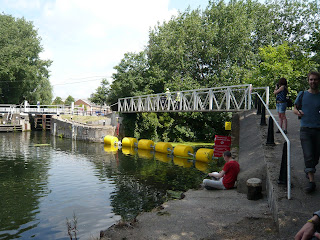
The patrol passes over the Lea bridge after declining the opportunity to be photographed. The fellow in the red shirt is sketching - I don't know if that's allowed or not.

Regeneration. My wife tells me that the feng shui of this building is radioactive, with the pointy bits jutting over the water or something.

The Northern Outfall Sewer just before it becomes the Greenway.

"J.W. Bazalgette, Engineer." Yes he was.

The stadium from the Greenway. Impromptu office buildings in the foreground.

Here you can see part of a scaffolding causeway connecting the site with the Greenway. It's a bad photograph because some security gentlemen became very agitated when I attempted to take a good photograph.

London Concrete, with Canary Wharf a surprisingly long way in the background.

View over the site's main vehicle entrance. I assume it was the main vehicle entrance, because there was a vast amount of traffic - a constant stream of lorries, plant and buses entering and leaving. This was on a Saturday. There was a terrific sense of industry and urgency. In the background is the skeleton of Zaha Hadid's Aquatics Centre.
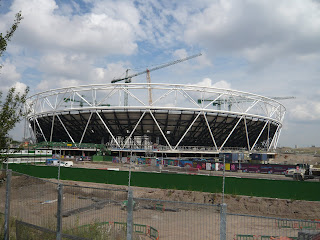
The stadium. In the foreground are some brightly coloured hoardings with commands directed at site-workers on them: "Be Aware!" "Be considerate!" "Be responsible!" Construction workers are always harangued like this, but it's a distinctly authoritarian touch in the Olympic typeface and the New Labour fluorescent palette. DCMS meets DPRK.

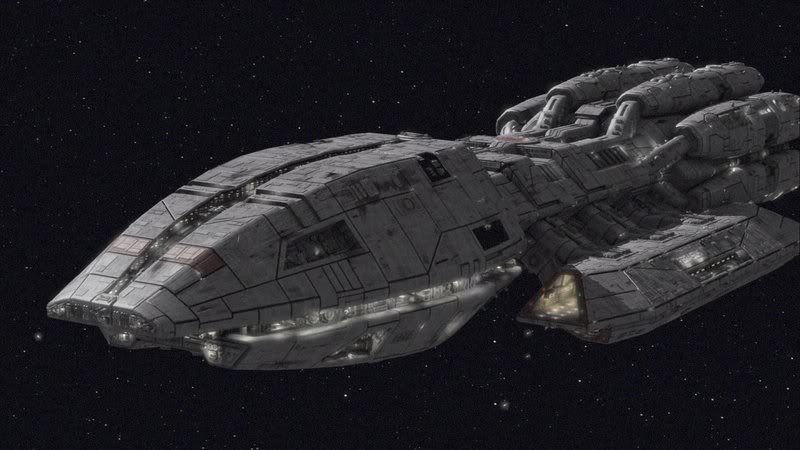
A closeup of the Aquatics Centre. I generally try to avoid "alien spacecraft" cliches, but it could be
Battlestar Pegasus in the shipyard.

A stretch of the Greenway that had been popular as a viewing area had been fenced off - more nibbling at the public realm. Security men stood watch.
It was hot - very hot. There is little shade on the Greenway. The security guard who was watching the former viewing area had improvised a little shelter by attaching fallen branches to a fence. Not an enviable job, standing there all day.

Who's this "us"?

Into "the labyrinth", where the Greenway has been closed and pedestrians have to pass through what amounts to a security checkpoint in a dogleg bend.

Inside "the labyrinth". Places like this are fascinating. I'm increasingly interested in the subject of zones and the disintegration of the city's public space into a patchwork of varying legalities. Our state society is becoming increasingly fixated on identity, ID. This concern is presented as a result of concerns about terrorism (of course), but also as a way of safeguarding "our" rights so that they're not "abused" by people who don't belong in the magic club of citizenship. Look at the first groups affected by ID card legislation - foreigners resident here, and airline/airport staff with access to the sacred "airside" zone - simultaneously one of the most secure and insecure places in the UK, the place we overlap with the rest of the world. Anyway, ID obsession is no way of guaranteeing rights, it's a way of denying them, ultimately breaking the whole city and country into spaces where people "belong" and (more importantly) "don't belong".

At the moment, with little ID infrastructure in place, when you're in a semi-public but highly controlled space like "the labyrinth", the authorities are forced to assume that you belong. They hate this. With an ID infrastructure in place, they're safe to assume that you "don't belong", and the onus is on you to justify your presence there. In places like "the labyrinth", we can see the architecture and mechanisms of this infrastructure being rehearsed. It is at its most developed, I think, in the West Bank.

David Kendall in "the labyrinth".

Something a bit Wild West about this gate. Appropriately, it was High Noon.

A bowser spraying water - I think to keep down dust.

On the left, one of the ugliest buildings in London. Portacabin aesthetics.

For pity's sake, that's atrocious.

The Fence absorbs a signpost like some spreading alien presence out of early JG Ballard. No through road.

I love this photograph. The church is gone.

Lock-keeper's cottage, a bizarre survivor just off the ultra-urban main road into Stratford. New security infrastructure keeps an eye.

Greenway fact: Gandhi like to walk along it when he was a law student in London before the First World War.

The fence was punctured up ahead - they appear to be building a jetty for accepting deliveries by barge. We went to have a closer look.

The path along the riverside had been blocked by The Fence, and the fly-tippers have moved into its amputated remains. Some fibreglass cornices from an obsolete effort at home improvement.

Fly-tippers. The filth here was indescribable.

RIVER. Plus blocked archway, as if it has been filled in with that coloured gunk dentists use.

This was the only Union flag I saw on the site, which was something of a surprise. I expected more national symbols.

I only saw one of these, as well - inconspicuous, bolted to the end of a crash barrier. An early hint at future walking routes, or a leftover from an old route now truncated. We terminated the walk at Pudding Mill Lane and went to Greenwich for lunch and to discuss the day.
There are more photographs on my
Flickr stream.