Showing posts with label London. Show all posts

Wednesday, 6 June 2012

Appearances in June

Not much in the way of print this month (more in July), but two real-life appearances, both next week.

On Monday 11 June I'm reading at the wonderful regular lit night The Book Stops Here. Also appearing are two other novelists: Emily Perkins, whose most recent book is The Forrests, and Chibundu Onuzo, author of The Spider King's Daughter - a fellow Desmond Elliott Prize longlistee and one of the Guardian's literary talents to watch in 2012. It's at The Alley Cat, 4 Denmark Street, London WC2H 8LP - the event is free, doors open at 7.30pm, readings start at 8pm. Come!
Update, 11.6.12: Also reading is DW Wilson, winner of last year's BBC National Short Story Prize, who has either just been added to the line-up or (more likely) I missed the first time around - for which, apologies.

On Wednesday 13 June, I'm taking part in the launch of USELESS: New Writing in Art and Design, a publication produced by the students of the Royal College of Art's inaugural MA in Critical Writing. As the name suggests, the theme of the publication is USELESSNESS, a subject I'll be saying a few words about, before a series of performances on the theme. I led a couple of workshops on this project and the work being produced was really first rate - if you want to get a taste of the next generation of design writers then this is the place. The event is at the Banner Repeater gallery in Hackney and starts at 6.30pm. As far as I know it's free. Come!
Update, 11.6.12: More details about the event here. DJ sets by DJ sets by David Crowley, Brian Dillon, Jeremy Millar and Nina Power. Unmissable, I'd say.

Sunday, 20 November 2011

Occupied


Photo by me. This post sat in drafts for ages, which is why it's a bit behind the times.

When Paternoster Row, adjacent to St Paul's Cathedral in the city of London, was destroyed by fire during the Blitz, 6 million books were consumed by the flames. For centuries, the area was the centre of London's bookselling and publishing trades - before Fleet Street, before the Charing Cross Road, before Bloomsbury. Robinson Crusoe was published there [1]. Its destruction was the terminus of that part of the site's history; the area was rebuilt as Paternoster Square, which was first a modernist office complex, and since the 1990s has been a deadly historicist Carolingian showpiece. It is home to the London Stock Exchange, now targeted by our local representatives of the Occupy movement. Unable to camp in the square outside the stock exchange - this so-called public space is privately owned, and was promptly sealed off by the police - the Occupiers have set up in St Paul's churchyard, prompting a continuing crisis at the cathedral and much public debate, which I won't recap here.

The one incursion the Occupiers have been able to make into the Paternoster complex is to stick posters and other ephemera on the pillars of its external colonnade - as shown in the photo above. I have fairly mixed feelings about the occupiers[2], so took the opportunity one evening a week or two ago to go down to the site and look around for myself. I found an orderly, friendly and essentially unobstructive protest. But I was most charmed by the informal poster-pillars, which immediately reminded me of the area's publishing history - nearby, the Occupiers have also set up a "library", and those book-covered tables seemed another connection to that past.

Recently I was at the Architectural Association, attending Thrilling Wonder Stories 3, a conference of speculation. There, Kevin Slavin gave a fascinting talking about the rise of "algo-trading" - the use of algorithms to trade stocks. You can't just buy or sell a million shares of something without undesirable market effects, so algorithms are used to break up that one big trade into many small, seemingly random trades. More algorithms are used to try and detect those programmes. So much trading on stock exchanges is now automated, and that in turn is changing where trading occurs. Microseconds can make the difference between profit and loss, so the banks of computers running these automated trades are increasingly locating themselves around switch hubs, the "telephone exchanges" of the internet. This reduces the lightspeed travel time of their commands to the market - and also moves them away from traditional financial districts. Increasing auomation, and the migration of this automation, means fewer and fewer actual people working on Wall Street and in the City - and thus Slavin compares the Occupiers to hermit crabs, taking over an abandoned shell after its previous inhabitant moved on.

What I think is most striking about the Occupation is the reoccupation of public space in the city with visible ideas. Of course the powers that preside over the City have ideas, they have an ideology. But it serves their purposes to not really advertise those ideas, so that we almost forget that they have ideology at all, and believe that they are mere innocents, "entrepreneurs" frolicking wealth-creatively in a benign state of nature, a fragile state at that, one which must not be disturbed for fear that they might just take off like deer. The City is a very strange place indeed, and has been for decades. For most Londoners, the ones who don't work there, it's just a kind of lacuna, mostly only regarded from a distance. And the City I think favours this semi-visible status, which is why it has happily driven other uses (such as the publishing industry) from its bounds, and would like to do unto Smithfield as it did unto Spitalfields. Its penetration by visible dissent isn't threatening to it as an obstruction or as a way of stopping its work - the Occupation really doesn't obstruct anything significant. The threat is connected to the possibility that is might have to explain or justify itself. We might have to think about what is done there, and how it is done. Which is, in a democratic society, a generous public service by the Occupiers.

[1] These facts from the Encyclopedia of London.
[2] Which aren't important. There has been much griping from the Do Nothings about Occupy, I don't intend to join in.

Monday, 15 August 2011

Shutter Island


Image from photoshoplooter.

The post-8/11 city hoves into view; it galvanises, if you will, its metal carapace dull in the late summer sunshine. In response to the riots of last week (only last week?), the government's "chief planner" has asked councils to consider easing planning regulations for metal shop shutters. Pause for a moment to reflect on what British "planning", a term that used to entail a degree of thinking ahead, has been reduced to: a measure so reactive it serves as an update to the old saying "shutting the stable door after the horse has bolted".

Reactive and, it seems to me, futile. One of the most arresting images of the looting that accompanied the riots was of metal shutters being yanked off shopfronts by dedicated teams of youths*, a sort of "unboxing ceremony" for those perhaps unable to derive regular doses of fulfilment from consumer technology. Of course shopkeepers have a right to not have their goods stolen, but this alteration does nothing to reduce the risk of future riots. It is little more than security theatre - allowing shopkeepers to make a feel-good purchase that will help them sleep a little easier without doing much to aid them in the event of resumed rioting.

For the neoliberals in government, it must be ideologically appealing to respond to the riots with an act of deregulation, however minor. For the rest of us, it is significant that this intervention takes place in the space between the things that are for sale and the people who want to buy or steal those things. This space is called the street - it should have other functions as well, but one of the most depressing aspects of the recent unrest was how it rammed (ramraided?) home the fact that consuming is increasingly the only thing that can be done in a street, even during a riot. This domination by commerce, and the dwindling of public space that goes with it, must be seen as one of the key causes of the riots.

Anyway, here come the shutters. My hunch is that this alteration to the rules will have most impact outside the great cities, in small towns and villages where the mob looms large only via the Mail and the Express. In most of central London, the night-time streetscape is already heavily metallised, so it's hard to see what difference will be made in those areas that actually experienced riots. The shutters are such an established aspect of East London's streets that they have prompted their own subgenre of street art. The king of the shutter artists is Ben Eine, whose giant colourful capital letters adorn scores of after-hours shopfronts in Shoreditch and Bethnal Green. They're very likeable, bright and pleasant, undeniably an improvement on unadorned (or rather tag-spattered) steel, but also deeply safe. Their jolly colours and the Smarties-cap collectability of the letters give them an infantile edge; there's something sedative about them, the aestheticisation of a hardened landscape, a harbinger of hipsterisation.

Eine's shopfront graffiti is so safe, in fact, it comes with a government endorsement - a Conservative government endorsement, no less. A year ago David Cameron presented President Obama with one of Eine's paintings as a gift. The name of the painting, spelled out in those cheery vintage shuttercaps, was "Twentyfirst Century City". The steel shutter thus emerges as the perfect symbol of the Cameronian cityscape, open for business and closed for everything else. Even then, the symbol must be carefully tuned; we wouldn't want to be too edgy. "Twentyfirst Century City" was the most appropriate text Eine could find in his studio at short notice - rejected paintings included "Monsters" and "Delinquents", which would have sent quite the wrong message.

Update: I completely missed this post with some views on shutters, which has some interesting points of view on the subject, particularly in the comments. Via Sam Jacob's Twitter feed.

* Precisely the sort of coordinated effort that has in recent days been condemned as "mindless".

Monday, 13 June 2011

British Paradoxes

"London, where the streets are paved with gold, and the gardens with cement", leads a Guardian article on the loss of wildlife habitats resulting from people paving over their front gardens.
The biggest survey ever conducted of private space in the capital, taken by the London Wildlife Trust, shows it is getting greyer – threatening its reputation of being one of the world's greenest cities because of its extensive public parks and gardens.

The city is losing the equivalent of two-and-a-half Hyde Parks of greenery a year from its private, domestic gardens – about 3,000 ha (7,410 acres), says the report.

Lamentable. So what is to be done? Legislation, perhaps, or biodiversity conversation areas to go with the existing system of conservation areas? But what about the Briton's inalienable right to do whatever he pleases to his home? But of course we are in the fork of a defining British paradox. We have this generalised sense of a shared patrimony that must be protected, which we sum up as our "heritage". And yet we also have this pugnacious sense of private property and natural justice, of rights and entitlements. So the very person who might complain about the loss of butterfly habitats and deterioration of streetscape caused by his neighbour's concreting of his front garden might be apoplectic at rage if the council stopped him putting up a shed in his back garden. Both sides of this paradox are of course "common sense", and reason buckles under the distorting pressure of its internal contradictions.

Similarly, everyone wants a home with a garden - surveys repeatedly show that this is the national preference. If this is what people want, then it must be right, that's just common sense. And everyone wants total protection of the green belt, and indeed all undeveloped green space. Where are these homes going to go? So we end up with absurd, cramped brick boxes on ludicrous coasters of turf - an attempt to meet a typological requirement in defiance of all reason. We very obviously share many things - our cities, our countryside, our past. And yet we despise the idea of dealing with them in a communal manner.

These paradoxes - and there are dozens like them, on everything from the "nanny state" to the BBC - are the logical outcome of 30 years of government according to the vindictive petty jealousies of the Daily Mail. They are rooted in that poisonous discourse, in which it seems every politician talks to you, personally, as an individual - you are of course responsible, hard-working, ordinary - in order to warn you about the others, the ones who are taking advantage and ruining everything. It is a mean, small-minded pattern of thought, the politics of Gollum. It has stacked this country with lose-lose paradoxes and zero-sum games, and at times it feels as if these paradoxes are about to block out all light from above and hope of change. Like when a Labour leader stands up and - instead of announcing a national programme of housebuilding, which would allow thousands more to share in the benefits of a council home - announces that "hardworking, responsible" people (like you!) would be given preference for the existing tiny number of council homes, over the "shirkers" (you know, the others).

Saturday, 4 June 2011

The Latest Hallucinations


I've been up to my neck in "proper writing" and neglecting the blog lately. So this is one of those somewhat unsatisfying "read me elsewhere" posts - made extra unsatisfying by the fact that a lot of this stuff isn't online.

One thing that is online is this review of a small show in Eindhoven called "The New Psychedelica". The show really scratches an itch for those of us who feel that art hasn't really plumbed to depths of weirdness offered by the digital world.

Also online is this review of Locals Only, a photographic record of California's 1970s skate culture, at men's style website Jock & Nerds.

The new issue of Icon has a long piece by me mulling what London's new crop of skyscrapers means for the city, in the company of sculptor, polymath and expert Londoner Richard Wentworth. There's also a much shorter piece by me about David Chipperfield's Hepworth Wakefield.

Print-only (for the time being) but free is The Clerkenwell Post, an attractive zine about all things Clerkenwell. It was produced by Icon's publisher and launched at Clerkenwell Design Week. If you're in the area copies can still be found - there's a piece in there by me about the Barbican.

Pretty soon there'll be a flurry of news about the novel, now a mere eight months away from publication. Only eight months! It seems like just six months ago it was fourteen months away from publication. But here's something: you can pre-order it on Amazon now.

Next week there will (I hope) be some news about the Secret Project which has been eating up a lot of my time behind the scenes.

And I will be doing more blogging soon.

Wednesday, 23 February 2011

Fox in the Shard


The Shard. Image taken from the Flickr stream of Michali_ and used under a Creative Commons licence.

This post contains a minor spoiler related to the book Chronic City by Jonathan Lethem - not enough to ruin anyone's enjoyment of it, I think, but still - you have been warned.

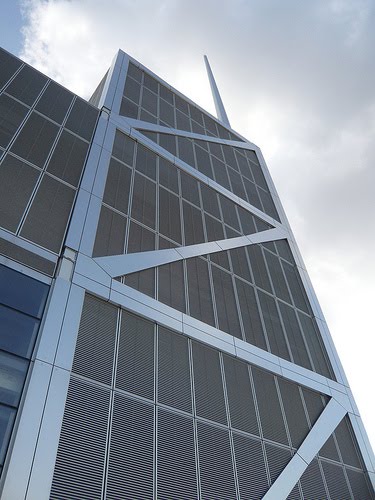
There is something magnificent, and melancholy, in the rumour that Southwark Council is scrambling to catch a fox that is somewhere on the 75th floor of the Shard, the Renzo Piano skyscraper currently under construction in London. It is, in fact, easy to attribute romantic, even heroic attributes to the (putative) animal. There's the dangerous charm of the fugitive, of course, still a potent presence in the British psyche as the bizarre Raoul Moat case demonstrates. And there's something else. The rise of the Shard is a PR endeavour as much as it is a feat of construction. "Shard" is an official name, not a popular nickname; it's right there on the jumpform rig. An image is going up at the same time as the building.

The fox - even as a rumour - is an unchoreographed intrusion into this careful brand-building. A rogue presence has installed itself in the highest reaches of the tower and insolently eludes the authorities. Higher than highest - the tower will only have 72 habitable floors, so if the animal really is on the "75th" floor, it is at the summit, the unbuilt point of the spike. Underdog, meet overfox. This wasn't part of the PR strategy.

So, true or not, the rumour suggests the first inklings of popular mythmaking around the new tower - the city accepting the building into its collective imagination. Phantasmic Mr Fox can be seen as a sliver of public affection for Shard. In that, it brings to mind the escaped tiger in Jonathan Lethem's 2009 novel Chronic City. Lethem's tiger continually evades the authorities; capable of demolishing whole buildings, its effects are excessive even for a big cat. Rumours, lies and conspiracy theories swirl around it - it is a symbol in a book filled with symbols. Chronic City's New York is a strange, troubled place, unnerved by its own gentrification and regeneration, marooned in introspection. The people feel they have lost something, that something is amiss, and their attention transfers to mysterious absences: the tiger and the buildings it conveniently clears out of the way, ready for regeneration; astronauts trapped aboard a space station with no hope of rescue; gigantic chasms carved by a monumental land artist called Laird Noteless (note: less); "war-free" editions of the newspaper.

Foxes have thrived in London in recent years - they and the super-rich seem to be the only things in the city that have no trouble finding new places to live. Their eerie calls can be heard earlier and earlier in the evening, and they appear bolder, less afraid around people. Of course it's please to think of a fox brazenly in residence in the nosebleed section of the aspiring spire, barking that three-part cry, a vulpine muezzin in the city's best minaret. The Shard is a magnificent building, and it's hugely exciting to see it rise; the fox's presence seems to say, yes, this belongs to us too. What a view it must have, if it's there. And even if it isn't there, someone has seen fit to imagine it there, and that's almost as good.

UPDATED 16:45 24 February: It was real, it was on the 72nd floor, and they caught it! You can read the story here at the Standard. Says the article: "It is thought to be the highest distance ever recorded to have been made by a fox." Carve that one into the annals of pest-control-at-height. And I like its defiant expression. It's seen things, man, things you wouldn't believe. It can go back, but it won't be the same.

Sunday, 26 December 2010

On Pool


Over at the Bi Blog, there's a new and quite short piece by me on the theme of "Pool". I talk - briefly - about what George Orwell thought of London's suburbs. The (rather lovely) concept of the Bi Blog is that two writers riff in different directions on the same subject; my opposite number, Erandi de Silva, writes on Sunset Boulevard and reflecting pools.

Tuesday, 26 October 2010

The Leyton Roar

This article originally appeared in Smoke: A London Peculiar #16 and is reproduced here with permission.


Someone is fighting a lonely war against noise on the Central Line. The shrill tone that announces that the doors are closing is too loud for them, or too high-pitched, or both. They scratch their complaint into the doors: Excessive Door Noise; Noisy Doors Cause Deafness; Too Loud. Always the same hand, the same terse concision. How long has this been going on – scratch-scratch-scratch attrition on one side, deafening psy-ops on the other?

Meanwhile, almost unnoticed, part of the Central Line has lost its voice. Perhaps the anonymous vigilante of quietude is pleased, but it’s really a cause for sadness: The Leyton Roar is gone.

At its furthest eastern reaches, between Epping and Debden, Central line trains roll through actual countryside – fields, cows, hedgerows. Heading west, towards London, the city composes itself out of fragments. Scattered semis link arms into terraces, playing fields shrink and evaporate, urban pressure closes in around you. At Leyton, the gathering density pushes the line underground.

As if to make it clear that Leyton is a threshold, there is an enormous, crowded Catholic cemetery next to the station. Graveyards are traditionally placed at a city’s edge, for hygienic reasons and to satisfy their demands for space. The approach to the tunnel mouth has none of the flamboyance of the cemetery, but there is a grave quality to it: the long downward slope is like the ramp leading into the tomb of an ancient civilisation. This sense of the monumental is reinforced by the rising filthy retaining walls, bruised pink like the walls of the Forbidden City in Beijing or Delhi’s Red Fort, or the exhausted moquette of older Central Line seats. The portal itself is modest, stained with decades of abyssal grime.

This eastern entrance to the city used to be far more impressive, though, for it had an aural architecture too: The Leyton Roar. When a westbound train entered the tunnel, a powerful wave of air would blast through the carriage with a high-volume shriek, loud enough to silence any conversation and surprise the unsuspecting: people would be cut off mid-sentence, or roused from their newspapers. Even for city ears accustomed to tuning out announcements and the Tube’s general background thunder, this noise was impossible to miss. It was a signal, a portent, an apocalyptic howl that far exceeded the usual Underground cacophony. Like a triumphal arch or a gate, it announced that the train had entered the city. And now this landmark is gone. Now, there is simply a dull whoosh when the train slips into the tunnel. No one looks up, and conversations continue.

The sudden disappearance of The Roar unnerved me. Why had it gone? The trains were the same, the tunnel was the same – how could the sound of the journey change so dramatically? These changes are important. If such a noise made a sudden appearance in a routine journey, it would give pause for thought; its disappearance might be more subtle, but is no less significant.

I e-mailed the Transport for London press office. A month passed without reply. I e-mailed again. This time, there was a response, from Benedict Pennington, head of the London Underground press desk. “I believe the difference you will have noticed will be as a result of track and ballast replacement,” he wrote. “This involves removing all the rails and aggregate which the rails sit on, and replacing them with continuously welded rails, rather than blocks of jointed rails. This would alter the ride noise on board our trains.”

That wasn’t wholly satisfactory. The Roar hadn’t seemed to be a product of the ride noise of the trains. But if the removal of the aggregate meant there was now more space, then maybe the train would be less like a piston smashing against a wall of pressured air as it entered the tunnel, resulting in a quieter passage – maybe? “Track ballast replacement” – it was shaped like an explanation, and filled the hole where an explanation should be, but did not really explain anything.

Once a day I still listen out for The Leyton Roar, and listening for a sound that isn’t there breeds a kind of super-sensitivity – it’s as if there is now a negative space where The Roar once was, a new space of quiet carved out of the Tube thunder, in which creaks and sighs that would otherwise rush past unnoticed suddenly stick out; and that thickening in the ears, that perceptible increase of air pressure against internal membranes, that movement of blood in the darkness – a new roar.

Meanwhile, the scratch marks still appear on the doors: Noise Pollution; Inappropriate Door Noise. Somewhere out there, the Noise Vigilante is still at work.

Wednesday, 18 August 2010

Saint Jane


The Pelican edition of Death and Life, with cover by Germano Facetti.

A spectre is haunting urbanism - the spectre of Jane Jacobs. The American-Canadian writer and activist died in 2006, but she continues to exert influence over the urban debate, primarily via that dreary federacy of messianic dovecote enthusiasts, the "New Urbanists", who have taken her up as a kind of guiding prophet. Outside the ranks of the Kunstlers and Kriers, there is a great swath of architects, thinkers and writers on the city who have read Jacobs and hold her in high regard. With a touch of embarrassment, I should include myself in this latter category. Not being an architect, I was an auto-didact in urban theory. When I came across a Pelican edition of Jacobs' best-known book, The Death and Life of Great American Cities, in a second-hand bookshop almost a decade ago, I had never heard of her. But I loved the Germano Facetti cover design, the back sounded interesting enough, and the price was right, so I took it home.

At that point, my reading on urban theory had been scattershot, based entirely in what I found in 2nd-hand bookshops: Corbu, Lewis Mumford, Thomas Sharp, Steen Eiler Rasmussen, an odd band who had given me all sorts of interesting ideas and imagery, but nothing very coherent. What they had in common, more or less, was that I didn't really enjoy reading them all that much, and had mostly got through to the end in a spirit of patient self-improvement. I picked up Jacobs, expecting more of the same, and instead ploughed through it in a matter of days. If nothing else, she taught me that book-length urban theory could be hugely entertaining, and since then I have sought out books about the city with enthusiasm, as opposed to a worthy sense of I-really-should-know-more-about-this. (I haven't read The Economy of Cities which I understand unwisely broadens some of Jacobs' microcosmic conclusions, which is probably why its profile has declined in recent years while that of Death and Life has done little but improve.)

At the time, I lived in a basement flat in Pimlico. I worked from home. From the desk where I read and worked, I could see feet passing on the pavement outside. I could stroll out during the day and visit the market on Tachbrook street, which had a book stall. I knew the names of local shopkeepers. It was, when I had money, all very comfortable. Westminster council was on its never-ending crusade to fuck up everything with vast shiny office buildings. Jacobs had an obvious appeal in this context. Since then, I've learned a lot more, but much of what she says about the folly of monolithic single-use zoning and the importance of mixed activity on the street, still seems to me to be self-evident.

She has remained on my mind since, popping up from time to time in both expected and unexpected places. I recently read Joe Flood's account of New York's 1970s organisational meltdown, The Fires (review scheduled in Icon 088). Flood has a criticism of some form for nearly everyone in 1970s New York - except Jacobs, who floats, omniscient and benign, above the crumbling city. This kind of veneration obviously grates with some people. In an essay in The Atlantic, Benjamin Schwarz complains that the writers Sharon Zukin and Michael Sorkin are hopelessly in thrall to Jacobs in their recent accounts of NYC, and that Jacobs' description of the city was a mirage - if it ever existed, it was only for a split-second in the city's life.

Jacobs, Schwarz complains, presented a "transitional and unsustainable, if golden, moment" in the life of a certain neighbourhood as an ideal, and in doing so distorted our whole idea of the urban good life. This critique was picked up by Kosmograd: ever since Death and Life, urbanists have been attempting to conjure a steady-state Jacobs Moment in neighbourhoods globally, and always end up with a runaway reaction on their hands: gentrification. Working-class communities and affordable housing are swept away, and the district ends up as a "bo-ho theme park". Jacobs' "sentimental ... matronising" opinions have precious little to offer a world that is throwing up such terrifying urban environments as the FoxConn complex in Shenzhen.

When I first read Schwarz and Kosmograd's essays, my first instinct was to spring to Jacobs' defence. She was a lone voice raised in defence of a certain kind of community. That community was worth defending - the contemporary notion of what constituted a slum was a nonsense, a nonsense that was being used as a tool for massive and wholly un-progressive urban clearance and social engineering. This clearance was not the comprehensive redevelopment and state planning that took place in the UK - Moses-manner planning was an unlikely and grotesque, wholly corrupt, public-private aberration, one that sadly proved repeatable within the USA; imagine PFI joint ventures crossed with the LDDC and given untrammelled power, and you get a rough idea. At the time Jacobs wrote, gentrification and yuppification were inconceivable: New York would continue to experience the flight of the middle classes for 20 years after the publication of Death and Life. Industrial New York might not have been pleasant, but its destruction was a man-made disaster: the city deliberately dismantled its blue-collar manufacturing base in pursuit of white-collar employers, and almost killed itself in the process. (Flood details this insane policy in The Fires.) So Jacobs has nothing to offer the inhabitants of FoxConnopolis - she didn't have much to say about the Gaza Strip or Dubai, either, because she was writing about local issues in the 1960s. Jacobs could not be held responsible for what has been committed in her name by the New Urbanists and their insipid watercolour view of the city. Also, wasn't a lot of the disdain for Jane a distaste for her (American, rather twee) literary style? And the book has this great Germano Facetti cover. Don't you see?

In other words, Leave Britney Alone.

That was my first instinct, but thought better of it. For a start, I didn't particularly want to write an ode to Jacobs and place myself in the company of the Nurbanists. Secondly, it wasn't long after the ArcelorMittal Space Tangle controversy, and I didn't want to get into an argument with Kosmograd again, given that he's one of the most interesting and perceptive architecture bloggers in the UK, and I'm generally behind him 100%.

Anyway, the cult of Saint Jane is developing into a menace. It's worth mentioning that Death and Life is not really (or not wholly) an attack on modernism. Besides the Moses approach to planning, Jacobs is primarily arguing against decentralisation, "decentrists" such as Mumford, suburbanisation, Howard's "Garden City", monolithic zoning, and residential monoculture. Although the organic, dense, city seemed chaotic, Jacobs argued, it could be understood; it had hugely complex systems, and the systems worked. In suggesting this, she was making the case that the technocratic city-as-diagram planners in the Moses mold were not replacing a chaotic lack of system with a working system - they were replacing a working system with a dysfunctional system. Many of Jacobs' ideas (particularly to do with mixed uses) can and should be safely integrated into modernist planning. Indeed, they have been - compare the mixed housing and culture of the Barbican with the Lincoln Center, a Moses project that Jacobs complains about.

However, in deposing the Moses planning priesthood, Jacobs cut the vestments for a new priesthood. "You have misunderstood the city," she says, "and I understand it" - as Kosmograd says, this equation meant that by bearing the relics of Saint Jane, the Nurbanists can set themselves up as the only people who understand the city, and swaddle their agenda in authenticity and legitimacy. They claim to be the people who understand the city, who tend the guttering pilot light of "vibrancy" that keeps it alive.

They are wrong. I am not going to presume to have a deeper understanding of Jane Jacobs than the Nurbanists, and attempt to snatch the relics back - they are, frankly, welcome to them. We are never going to move forward if we get bogged down into a recondite dispute about "what she really meant". But Jacobs appealed to me because it chimed with what I saw in cities and what I liked about them - and the Nurbanists have no idea what this quality is. Their agenda for "neighbourhoods", "contextuality", "walkability", is fundamentally anti-urban. These qualities aren't necessarily bad in themselves - but combined in pursuit of the singular Nurbanist vision, they mean the vivisection of the city into un-urban cells. Taken to its conclusion, "walk-to-work" ideology means cottages clustered around the mill. While a short commute is desirable, in a neoliberal world this would severely limit social mobility and the overall broadening of horizons that is the best the city has to offer. If people wish to live within walking distance of their workplace, they of course should be able to. But basing a housing system on proximity to workplace is not progressive - or at least it is not as progressive as cheap, plentiful public transport and cheap, plentiful rented accommodation. The FoxxConn workers live in and around their workplace.

The Nurbanist vision of carving up the city in this way is as diagrammatic and retrograde as Moses' planning - and, similarly, it's an assault on the complexity of the city, the city's ability to generate its own fabulously complicated internal patterns that defy cursory inspection. The emphasis on little neighbourhoods, the stoop, local shops and walking distances, the "human scale" only tells part of the story of the city - after all, these things can be found in villages and small towns. All cities need sublimity, a touch of holy terror, a defiance of human scale that asserts connection to the greater urban whole. Elevated highways, crowds, tall buildings, interconnection and confusion - these things can be to some people dismaying and unpleasant, but the awe they strike is the overture of accepting the condition of living in a city. The Tube roundel is vaguely holy to Londoners - intensely reassuring - because it is a sign of connection with a system of vast complexity and importance. (The religious meaning of the Tube is a subject I keep meaning to write about at some point.) Nurbanism stems from a fear and hatred of the modern city as it is - a hatred that is ideological, that cannot and will not be shown that there are reasons to like the neon snarl of the cities we have, and their inner flows and surges. This is a terrible frame of mind for a group concerned with urban planning. Jacobs, at least, liked the city, and liked it for factors that cannot be found in small towns.

Death and Life is parochial and highly idiosyncratic, a product of particular times and specific circumstances; as its critics say, a poor basis for general policy. Jacobs herself, though, can't really be blamed for making broad recommendations on the basis of her own experiences and beliefs. The trouble is that there are not more Jane Jacobs, more voices in the urban debate, giving different views of city planning from their own experience. It is mysterious to me that Jonathan Raban's Soft City - a book written out of love for and interest in the city, hugely perceptive about how cities work, without policy recommendations, simply a plea for what is valuable about the city as a huge civilising machine - is not venerated in this country. Anna Minton's Ground Control is the only really outstanding contribution to the urban genre in recent years, although of course I have high hopes for Owen Hatherley's New Ruins when it comes out. The mutations of cities around us, from Shenzhen to London, certainly do need new narratives.

Wednesday, 7 July 2010

Support Your Local Zines

I'm in Smoke #16 waxing psychogeographical about the Central Line. Specifically, I've written an elegy for the Leyton Roar, an important part of the Underground's aural architecture, which disappeared in mysterious circumstances some time ago. If you're not familiar with Smoke, it's a quarterly(ish) zine about London, with fiction, humour, photography, illustrations, and short observational pieces. You can get it in Foyles, the Tate Modern bookshop, places like that - but I'm horrified to read in an announcement this month that fully half of the shops that used to stock Smoke (and zines like it) back in (say) 2004 have now closed, including Borders; obviously their sales have suffered. This apocalyptic state of affairs has forced them into a major retool, and it looks like they're toying with a new format or direction. I look forward to seeing it, but the news is a horrific reminder of just how bad things have got for independent culture in the city.

I was due to discuss some of the problems facing print, and the evolution of electronic media, at the British Creative Exchange event "Creative E-Zines & Design Publications in Progress". However the event has now been called off, because the chairman was injured in a car accident yesterday. Those of you who had already bought tickets should be able to get them reimbursed fairly quickly. The BCE tells me that they may reorganise the event at a later date.

Thursday, 24 June 2010

Air Rage


Image from my Flickr stream.

Filed under "I really shouldn't read the Standard, still it's right there on the seat next to me and sometimes Kieran's in it BLOODY HELL SO ANGRY":

The new owner of Gatwick today dropped London from its name and pledged to wipe out all links with its BAA past.
[...]
The name will be written in the form of an italicised “signature” rather than in the uncompromising “Rail Alphabet” Helvetica font used by BAA since the Sixties.

Mr Wingate said: “We have done the logo in the form of a signature because we want the airport to feel very personal and that we absolutely care about passengers having a good time going through the airport.”

The new owner, investment fund Global Infrastructure Partners, unveiled a new look that it claims will “rekindle the original spirit of taking a flight — we want to make people enjoy it.” Much of the change is cosmetic but aimed at finally ridding Gatwick of its state-owned Seventies heritage.

"Gatwick drops London in £1.5bn revamp", 21 June 2010

The point of Helvetica is that it is neutral. It is extremely legible. It is not subject to cultural bias, regional variation, and the vicissitudes of fashion and corporate identity. It is designed, painstakingly designed, to create standardised signage. Standardisation might not be exactly sexy but it is extremely useful if you want to avoid the world being a confusing racket. "Uncompromising", damn right it is. It is also international, part of the global language of airports, flight, travel - exactly the kind of spirit that this cloth-eared rebranding exercise apparently wants to tap into.

Sure, it's only the logo, there's no indication that they're going to sweep away the whole glorious sign system developed by William Pereira and others. But that crack about "ridding Gatwick of its state-owned Seventies heritage" shows the dangerous prejudices in play. The spangly, gaudy, deliberately confusing world of the British Corporate Pleasure Environment yawns wide, an aesthetic scraped out of the more alarming malls and bars. Let a thousand defective touchscreens blossom. I had a disheartening experience while travelling through Heathrow Terminal 4 last month - wanting to check if my gate had been called, I the back of a cluster of flatscreens attached to a pillar. Thinking "Aha, flight information", I walked around to see the screens - and they were all ads. They were all ads on the next pillar as well. I had to hunt for info. The departure board is to the airport user what the altar is to the cathedral congregant. The boards should be magnificient, huge, dramatic centrepieces of the lounge, and reproduced on a smaller level everywhere in every side chapel, shop and cafe. That list of names! The world awaits! It's beautiful as well as useful. But I had to hunt. and you can see the same dreary though processes at work - "what this place needs is to be much less like an airport, and much more like Westfield".

The plans, they say, hearken back to the golden age of plane travel. I've been thinking and reading about that golden age recently, partly in connection with my article about the Boeing 747 in the July Icon. This golden age certainly existed - it ended when air passengers chose inexpensive mass transit over luxury boutique travel. That is a choice worth remembering. But one of the characteristics of golden age was service, something that I do not feel will be well served by scrapping check-in desks and replacing them with touchscreens. It might be very efficient - I've had mixed experiences with self-checkin - but it's not exactly personal.

"We want to make people enjoy it" - that note of coercion is a little worrying. And this emphasis on pleasure is equally unsettling. It's the Corporate Pleasure Environment again, endlessly pestering you to relax and chill out and treat yourself and so on, forever reminding you of what a great time you're having and see how it's just like Sex and the City until all you want is to be left alone. Want to make people happy, Gatwick? You can't. Want to help people enjoy the airport? Minimal queuing. Clear signage. Information accurate and prominent. Clean. Efficient circulation. Plentiful seating that you don't have to pay for by buying a coffee. Your italicised logo isn't going to make the tiniest jot of difference to anyone.

Friday, 4 June 2010

Heathrow Free Zone


Noise footprints around Heathrow. Image from the BBC.

The proposed third runway at Heathrow airport has been scrapped, and there will be no expansion at Stansted or Gatwick. Viewed purely in environmental terms (as it probably should be) this is the right decision, and hopefully it will increase economic pressure on the coalition government to do something about the lamentable state of rail travel within the UK (hollow, cynical laugh). Nevertheless, like most green initiatives, it is mostly just a way of buying us time as we make the transition away from a fossil fuel economy. There will come a time, hopefully in the relatively near future, when kerosene-burning aircraft are supplanted by hydrogen-burning aircraft (or a similarly clean technology). When that time comes, the debate on air traffic, like the debate on road traffic, will start again almost from scratch. We will find that the economic case for a lot of currently very unpopular infrastructure - runways, motorways - is back and stronger than ever. So for Sipson, the village that would have been obliterated to make way for the Third Runway, the reprieve might only be temporary.

So I wasn't surprised to read a letter in the Evening Standard suggesting that homes and public buildings are built around Sipson to make a Third Runway an impossibility forever. It's a bizarre view to take, given that the Sipsonians already complain that their lives are made hell by the airport. Sure, why not move in more residents, plus a load of hospital patients, sixth-formers or whatever? But there's some very strange thinking around Heathrow (and, to a lesser extent, the other large airports - but no airport is problematised like Heathrow, being both huge and embedded in the city).

If we were starting from scratch, Heathrow might not be the best site for London's main airport. However, we're not starting from scratch, and Heathrow has been an unavoidable fact on the ground for half a century. Large jets have been using it since the 1960s. It's horribly noisy, the traffic around the airport is a nightmare, and air quality is low. But this didn't happen overnight and it's not going away - there's no prospect of a technological fix in the short term and the airport's closure is just a fantasy of a few hardcore NIMBYs and green activists.

Given that it's a longstanding and persistent condition, it sometimes troubles me that the problem of noise around Heathrow has not corrected itself “organically”, as people move away. Obviously there are people living inside the Heathrow noise footprint (as illustrated above) who cannot move away because of their economic circumstances – either simple poverty or the knot of obligations and unfreedoms that come with being a “flexible” worker in our economy. But that cannot account for all of the population: many of these areas are prosperous. Presumably there is also a great deal of British stubbornness and inertia involved, not a negative force in itself, but it can come in the form of a peculiar denial of reality – the villagers of Sipson still maintaining their vision of a village idyll long after their Domesday settlement found itself up against the security fence of one of the world's largest airports, surrounded by London. This is understandable in the elderly, but you have to be fairly old to be able to remember life before Heathrow (where the modern jet engine was first heard half a century ago). Alongside this is Britain's bizarre secular religion, the cult of house prices, which holds that the value of one's home must always go up, and that impediments to this divine accumulation of grace are against nature itself.

I don't mean to condemn any of this behaviour, or to say that the people who live around Heathrow have no right to complain because they are free to move away if they please, or because they enjoy the benefits of cheaper housing. The area around Heathrow is a “zone of sacrifice”: the value of the airport to the city and the country at large is so great that the severe loss of amenity in the area around it is easily tolerated by those who aren't resident in its immediate vicinity.

But is there a more creative approach that can be taken to the noise footprint? What we have here is a readymade zone – an area held slightly apart from the rest of the city, with unusual hazards (the noise and pollution) and unusual advantages (the airport itself, its value as an economic engine and transit hub, the vast tangle of infrastructure that surrounds it. This area is ripe for experimentation. The ideas here aren't serious proposals; they're more an effort to show what kind of imagination could be applied to the Heathrow Zone.

Travel launchpad. Give residents within the HZ airmiles, to allow them to get more use out of the airport. Make the neighbourhood a destination for outward-looking youths; tie in with local universities.

Emporium. Limit sale of airfreighted flowers and luxury foodstuffs to the HZ, turning it into a global Covent Garden and destination for seekers of the exotic. Let souks and flowermarkets bloom in Hounslow. If people cannot do without their airfreighted goods, let them at least buy them in the areas impaired by air travel.

Data entrepot. Saturation wifi coverage. Data havens.

Free zone. Reduced restrictions on drugs and vice and incentives for an artistic population to move in, to create a west London Weimar Berlin. Legalise indoor smoking.

Transition burb. In the environs of the headquarters of British aviation, a massive source of carbon emissions, create a chain of neighbourhoods devoted to experimentation and training aimed at a post-fossil-fuel future – government research, but also small-scale architectural and social experimentation, retrofitting houses and teaching useful skills, funded by the airport. The alliance between Sipson residents and Greenpeace during the battle against the third runway might have represented a temporary alignment of interests rather than a lasting sympathy, but perhaps a more general compact could come of it.

Idle speculation, really. Nevertheless, the area around Heathrow is already a zone in a number of important and overlooked ways – it has different rules, different conditions, and an unusual and provocative relationship with modernity. It's a considerable area of interest, one that has under-explored potential.

Monday, 17 May 2010

The Ruins of Oxford Street


Old advert revealed by Crossrail works on Oxford Street. Image taken from the Flickr stream of John O'Shea and used under a Creative Commons licence.

Like space, London is curved. It sits in a bowl-shaped valley, curving it one way, and the river adds its own magnificent curves. This curvature throws up unexpected views - you find yourself in west London looking at the City with south London somehow in the way. These surprise alignments are probably the reason the city is such a super-locus for the psychogeographers. They are also an essential element of the city's guile. Even familiar places can suddenly look at you with a new face. Wait, you can see the Telecom Tower from here? But ...

On Saturday, I went for a long stroll, walking an indirect route from the Royal Academy (where I had been attending a symposium on JG Ballard and architecture) to Centre Point. Nearing Oxford Street, I remembered a DVD I wanted to buy, and decided to pop into HMV.

I was surprised to find that it no longer exists - it's among the shops being demolished to make way for Crossrail. I've been through the area on numerous occasions recently, but never really took in the extent of the works; so surprising was the removal of HMV that I took a walk around the nearby streets to see how the city had changed. The entrance to Tottenham Court Road Tube station on the south side of Oxford street is now a faintly absurd toy - I never before appreciated what a bad match the 1980s perspex-looking porte cochere was with the decorative stonework around it. Now the surrounding building has been removed, leaving just the stone arch and the porch, it's a outstanding architectural oddity. An old painted advert, for Veglio's restaurant, has been revealed (more on old adverts, "ghost signs") in a forthcoming post about Gavin Stamp's Lost Cities). Standing just off the Charing Cross Road, I saw a striking brutalist building that was completely new to me - except that it wasn't new to me, it was the YMCA on Tottenham Court Road, seen for the first time from the south, and at an unaccustomed distance.

My grandmother was in London during the Blitz. She remember how strange it was to have the city transformed nightly, with new views opened up. I'm struck by how much of our image of the city is made up not of the buildings that we can see, but what they obscure - they city behind the city.

Updated 25 May to add:


The Festival of Britain opens new views of London. "This chaos made a vantage point for London to admire her finest profile; visible before to few, seen by fewer, the 'North bank from the South' is now a sightseer's dream." Image from www.fulltable.com, via Things.

Everything That's Ever Happened To Me Happened Right Here


The Market Estate, Islington, days before its demolition. From my Flickr Photostream.

The most moving thing I've read in weeks, courtesy of the London Evening Standard. This piece, a look inside London's gang culture by Tony Thompson, is largely the Standard's usual lawnorder handwringing and scaremongering. But, touring the ganglands of Croydon with a young guide called Radar, Thompson captures an amazing moment:

"I love my ends," he says, his voice thick with emotion. "I can't explain it. People say, 'How can you love a street or a block of flats?' but it's where I come from. It's my roots. Everything that's ever happened to me happened right here. No one can take that away from me, ever. I won't let anyone take it away."

Beautiful. This is civic pride - an earnest attempt to take pride in something, at any rate. It puts a new complexion on the gangs and territorial gang warfare as systems of belonging. And Radar's love for his neighbourhood seems infinitely more genuine than a political establishment that dishes out ideas like Britishness days, "community payback" and national youth service. There's something here that's potentially a powerful force for good, a voice being drowned out by foghorn demonisation that goes almost unchallenged in the media.

(An aside: Radar is/was a member of the "Don't Say Nothing" gang which, by a strange coincidence, I've mentioned in print before, while reviewing China Mieville's book The City and the City.)

Wednesday, 21 April 2010

Ewww'll Be Sorry


Kosmograd's thoughtful and provocative post about the ArcelorMittal Orbit earlier today has reminded me that I promised to return to the subject, talking specifically about the structure and not about its imagery or the reaction to it. As Kosmograd says, the Orbit is a little more palatable when viewed side-on as a model, and not through the trippy Tim Burton-esque lens of Arup's absurd renders. From that perspective, it is possible to make out something almost Tatlinesque about it.

But there the constructive comparisons with constructivism must halt. I'm still not a fan. I hate what this monument represents (the thought of visitors in 2052 traipsing past a display praising Mittal's "vision" and "generosity" makes me sick to my stomach) and I dislike it as a form; its structural loops and swirls don't really appear to stretch the boundaries of the possible so much as show off how easy it is for us to build something unusual at this comparitively modest height. Still, K'grad's chiding of instant snark make me feel like I have little new to add to what has been a spectacular outpouring of denigration and disgust on the part of the commentariat, so I'll leave it there.

There is, however, something else going on, something that I think is interesting. Over the past few weeks I've tried to confront and interrogate my own distaste for this structure, feeling very uncomfortable about my dislike for it. The root of this disquiet is now clear. A lot of the Orbit's defenders - or at least the wait-and-see contingent - have made the point that many much-loved buildings and structures (the Eiffel tower, to take Kosmograd's example) were opposed and derided when they were new. This is true; indeed, it's a point familiar to modernists justifying groundbreaking structures to a conservative audience. Pugin and Barry's Houses of Parliament were widely hated. Pugin himself deplored the ugliness of the Victorian city against the beauty of the medieval city. So it goes.

I realised that I was frightened of being caught on the wrong side of history, of being one of the reactionaries who booed Stravinsky's Rite of Spring. This is not healthy. My only motivation for revising my opinion would be so I did not look like a stick-in-the-mud in the eyes of a future generation of Londoners who hold the Orbit to be magnificent, and who are proud of it as a symbol of their city. Obviously I would prefer to be on the side of the bold, the brave, the new.

But in this case that would be dishonest. As it is, the prospect of the Orbit rising over the East End fills me with gloom. Once the thing is up, perhaps familiarity will soften it. I don't know. Familiarity is the magic ingredient here, though. Come 2052, if the Orbit is still standing, I'm sure many Londoners, perhaps the majority, will like the Orbit and feel proud of it. This won't be an aesthetic judgment in most cases - it will simply be a product of familiarity, of being used to a structure and associating it with their home city. There's nothing wrong with that reaction, but we shouldn't lie to ourselves about it now out of fear of being caught on the wrong side of that future consensus. I wonder if the Orbit's defenders are (consciously or not) writing themselves into the desirable role of the visionary, farsighted minority who saw the potential of this structure when the herd around them pooh-poohed it; and if so they are acting against their own aesthetic judgement. (I don't mean to malign anyone in this, my own experience related above tells me how strong this desire can be.)

This nervous desire to second-guess posterity feels like a new phenomenon, a product of the modernist supremacy slipping into the past and the immense power of the "they laughed at Columbus" meme in a relativist age, or part of the same queasy cultural acceleration that means some artists and comedians now see outrage as a form of acclaim. Maybe it doesn't exist, and I'm projecting my own insecurities onto the critical scene. Still, if it is out there, I think it's worth marking it down as undesirable - it's as weary and irrelevant to today as knee-jerk appeals to historical precedent. It is looking into the rear-view mirror not to see the road behind but to see what the kids in the back seat are doing. Keep your eyes on the road.

Friday, 26 February 2010

Why Ambassador, With This Perimeter You Are Really Spoiling Us

I was in the Independent yesterday, mounting a weak defence of a heavily defended building.

That's as close to Joan Holloway as I'm ever likely to get.
A 30m-wide "stand-off zone" will make the new US embassy stick out like a sore thumb. "It could have been a lot worse," says Will Wiles, senior editor at Icon architecture and design magazine. "We already knew that security was paramount in the design – it's a big factor in the Americans wanting a new building in the first place. Any design would have this 30m setback, defined by the blast radius of car bombs."

This "stand-off zone" is one part of what's called "hostile vehicle mitigation" or "HVM" - a field of building I'm pleasantly well informed about, having attended a conference on designing for terrorism last year*. There are such things, for instance, as armoured trees; a growing tree can absorb steel bars that will help it stop or slow a rogue vehicle. These hostile vehicles are the car- and truck-bombs that give security planners sleepless nights and twitchy days. As I told the Indie, they're the reason the Americans have decamped to Nine Elms (they wanted a site with the necessary space for the defensive zone). The defensive zone itself was always going to be heavily landscaped, because if vehicles can just drive into your stand-off it's not much of a stand-off. And so all this "it's a fortress behind a moat" talk is old news - that is what the Americans wanted and what Kieran Timberlake has delivered. It's what all the other architects delivered as well.


Kieran Timberlake's winning design for the new US Embassy in London.

I don't see anything particularly fortress-like about the building itself, although the vaguely Corblike pilotis do suggest the hem of a skirt raised against scurrying al-Qaeda mice. Its apparent isolation and aloofness are products of the defensive zone. The contradictions built into the brief must have been impossible - welcoming but defended, open yet closed, War is Peace. This inscrutable International Style Cube is a suitably ambivalent response to that. A winsome and civil bit of Scandinavian modernism, all civic manners and democratic openness, would have been duplicitous to the point of being highly sinister. As I said to the Independent, but they didn't quote: "The symbolism seems rather appropriate to me: a shining city on a hill, surrounded by the most formidable defensive network ever known." And that skin also has potential. A complicated double-surface like that, with its brise-soleil, makes me think of fractals, and the way they contain a small area within a long boundary. It's as if the surface of the embassy has the potential to cover a far larger building, perhaps up to the street edge, but the building has shrunk back. Forgive the simile, but it's like the wrinkled skin of a detumescent penis. I mean that in a good way. Really.


New security structures outside the existing US Embassy's building in Grosvenor Square. Image from the embassy's own Flickr stream.

Duplicitous to the point of being highly sinister. I had to visit the American Embassy on Grosvenor square to get a media visa shortly before Christmas last year. Interfacing with the State Department's bureaucracy is an unpleasant and intrusive business at the best of times, whatever their efficiency and politeness (and they were efficient and polite). But progressing through the improvised security perimeter outside Arne Jacobsen's Eero Saarinen's embassy building was frankly dystopian. Part of a London square was militarised, with heavy hard defences. One progresses from queue to queue before entering the building, progressing to slightly higher echelons of security clearance each time depending on the paperwork one has brought with one. Unsmiling police officers with automatic weapons stare at you, and you realise that if you made a dash towards the building itself, you would have to enter an area of open space that designed as a killzone, surrounded by armed representatives of the Metropolitan constabulary. Behind crossfire plaza is the building itself, its generous Scandinavian spaces seemingly as distant as the country you are trying to visit. The contradictions of that space are horribly unsettling, with a strongly dystopian odour: we can see the structures of a democracy retrofitted with the apparatus of authoritarianism. It gives a sense of how far we've fallen in 10 years.

The new embassy is at least designed with these contradictions in mind, and is consequently fascinating. It's worth taking a step back to really admire what we're looking at: a building designed with explosions in mind. A shape formed by the manipulation of spheres of destruction. It could be the first London building built with attack from the ground in mind since the Second World War. (It's also a testament to the extraordinary power of terror: the fact that a few hypothetical malcontents with A-level chemistry and a driver's licence can race to the head of the queue ahead of a whole gang of other diplomatic considerations.) So, what new forms are these? Going back through my notes from that terror conference is a dispiriting experience; the bureaucratic jargon like "hostile vehicle mitigation" and "exponential decay of blast effect" does not exactly induce good cheer. There are some aspects of HVM that might give pause to Londoners. Firstly, it doesn't stop attacks, it just makes them more difficult and limits their impact. Secondly, it's primarily meant to protect facilities, rather than people. Obviously some people are protected into the bargain - I'm not saying that to make some Spartist the-Yanks-care-more-about-their-office-furniture-than-the-lives-of-honest-cockneys point, it's just a fact of life. 30m stand-off will prevent a truck bomb causing massive structural collapse, but said bomb could still cause horrific death and injury. Thirdly, HVM only protects the one facility, not the buildings around it. The plans for the new embassy show new glass blocks surrounding it at street's edge. Will they still be glass when they're built, I wonder.


That's something important to bear in mind: the effect of the new embassy's security measures extends beyond the perimeter of the embassy itself.

The Ministry of Love was the really frightening one. There were no windows in it at all. Winston had never been inside the Ministry of Love, nor within half a kilometre of it. It was a place impossible to enter except on official business, and then only by penetrating through a maze of barbed-wire entanglements, steel doors, and hidden machine-gun nests. Even the streets leading up to its outer barriers were roamed by gorilla-faced guards in black uniforms, armed with jointed truncheons.

- George Orwell, Nineteen Eighty-Four, Chapter 1; emphasis mine

The HVM landscaping creates what can be called a "hard zone" of security. There are also nested "soft zones" of security in and around the building: the sight arcs of CCTV cameras, the streets on which you are more likely to be stopped by police or prevented from taking photographs, maybe a "no-protest" radius around the building like the one around Parliament (now scrapped), no-fly zones. The electronic haze of listening devices and broadcasting devices, security down to the ions in the atmosphere. And there are the streets on which one may feel uneasy and prefer not to linger.


The now-scrapped Parliament no-protest zone. Image: BBC.

The hard defences of Kieran Timberlake's new embassy don't bother me in the slightest. They are obvious, they invite an architectural response, they can be well-mannered and attractive, and they are in their way honest. (I'm reminded of the temporary barricades around Parliament here - unattractive black slabs that were partly reclaimed when people started sitting on them to eat their lunch.) The new US embassy has the potential to be one of the most interesting buildings in London, and I would love to visit it once it is finished (although it's possible I'm now blowing my chance). Hard zones aren't such a big deal - no one complains about the Tower of London, a fortress behind a defensive setback on the Thames. It's these CCTV-covered, drone-overflown soft zones that we need fear. Although ID cards might not be here yet, ID card culture is. We face the slow advance of soft-zone ambivalence, that creeping sense of being unwelcome on the street, a desire to look over one's shoulder. Soft zones are easy to introduce and difficult to shift; they exist in the mind as much as in the city. A bollard is just a bollard, and it can't strike half as much fear into one's heart as the sudden sense that one has brought along the wrong piece of paper.

* "Places Not Fortresses: Can and Should we Design for Terror?", New London Architecture with the Association of Consultant Architects, at the Building Centre, 27 January 2009.

Saturday, 5 December 2009

London in 2010


I was 11 in December 1989. We said hello to the 1990s in a farmhouse owned by family friends somewhere in the North. That New Year, the Observer devoted its colour supplement to speculation about what London might be like in 20 years - in 2010. I was mad for cityscapes, sci-fi and futurology, and I really liked the pictures and some of the ideas in this colour supplement, so I kept it. About seven years ago, when my parents moved house, I found the magazine while clearing out my old room - I refrained from throwing it out, thinking it would be interesting to see how it held up in 2010. And here we are. How did they do?


I've photographed all 15 pages of speculation and they're up on my Flickr site, with some close-ups of interesting bits. (NB: click on the photos on this blog post for a closer look.) The text should all be legible. About half of the speculation is architectural - there are also pages devoted to transport and fashion, but I have little to say about them here.

To kick off the section, there are some short columns by Peter Hall (now a Sir, founder member of Blair's Urban Task Force), the late Tony Banks MP, Peter Kellner and the author Jonathan Raban (who has since contributed to Icon). These opening pensees are a stark reminder that London was considered far more of a "problem" back then - a potentially ungovernable, insoluble perma-crisis. London still suffers from terrible problems, and a crippling lack of vision in its governing classes, but beyond the fringe right I think few now see it actually failing and going feral on us.

Hall points to the need for Crossrail and high-speed rail links to the Channel Tunnel and Heathrow - a network we're still piecing together now, thanks broadly to the dismal stasis of the Major years. Banks draws attention to London's lack of a single governing authority - it now seem amazing that such a governmental vacuum was allowed to persist for so long, from 1986 to 2000. Kellner proposes surrender in the face of London's problems and suggests moving jobs around the country with a view to reducing the city's population by 2 million. Raban provides a direct and pithy rebuttal to Kellner's pessimism: "The nastier that London gets, the darker its peculiar charms, so people (not planners, or sensible journalists with a topic to follow) will be seduced by it ... Just as we love the romantic melodrama of the street in Dickens, we secretly love the growing horror-show of the city we actually live in." Hear hear.


Two different visions of the city in 2010 follow, the first of which is by Nigel Coates and Brian Hatton. Obviously, they get a hell of a lot wrong (London is no longer the capital - and why are blimps so seductive to futurologists?), but in some ways the vision is eerily prescient, even if the details are wrong. They see the influence of Charles persisting and deepening with the result that postmodern and neo-gothic facadism runs riot - "bad buildngs have approved facades", which leaves one to wonder who decides buildings are bad and who does the approving; hopefully not St James's Palace, or the the Carolingian pile Coates imagines built in Liverpool.

Bankside power station has been converted into a museum, although here it's the "Thatcher Museum of Commerce" - one shudders to think, presumably it would be full of brick-like yuppiephones and British Gas share certificates. (Tell Sid I'll meet him in the gift shop.) Another post-industrial museum is Waterloo station, part of which has been converted into a "Museum of Suburban Life". The other defining feature of Coates' London is high-tech parasitism, with exposed services, ducts and blobs creeping across the exterior of the city's buildings. He predicts the yuppification of Trellick tower, although suggests that its facade might need "softening" with a few blobs to allow this to happen. Other towerblocks have been "allocated to young single homeless at near-zero rents, giving limited sanction to social deviance".

Other aspects of the vision are beguilingly whimsical. "Crystalline telecommunications spires spike a new skyline ... Sony World Bank polysteeple overshadows the NatWest Tower, now a block of flats." The most interesting aspect of Coates' vision is his suggestion that the urban debate has shifted from "hardware" to "software" - away from monumental new building and towards flexibility, adaptation and reuse (those parasitic services and pods, and I presume the first inklings of the optimistic Blairite "live-work unit"). But this clashes with his belief in the continuing relevance of Charles - Charles, after all, stands firmly on the side of stasis. One thing Coates and Hatton get spot on: "King's Cross still a building site".


The second vision, by Stephen Gardiner and Joan Scotson, is much more conservative and also more tedious. It mostly consists of the removal of things that they don't like: St Thomas' Hospital, the Shell building, the Elephant & Castle complex and "high-rise housing" in general. Mostly, these are replaced with open space. The city's inner main roads are mostly also "replaced", with car-based commuting almost entirely replaced with public transport. They are light on details as to what form that public transport is to take. But by and large the vision starts with the premise that the city's history since about 1939 was a mistake, and should be set right. You can imagine.

Anyway, do go and check out the pages - my photographs are sharp enough to read the text clearly, and it's interesting stuff. Bring on 2030.

Monday, 27 July 2009

Urban Farming and Apocalypse Chic


Dalston Mill, London, 2009. Photo from Londonist.

When I was researching my recent feature on urban farming (Icon 072; not online yet, sadly), the same name kept coming up: Cuba. Cuba, it was said, was the face of the future: urban populations were effectively supplementing their diets from smallholdings within city limits, and were doing so with high yields achieved without agrochemicals. I now read on Carolyn Steel's blog that this isn't strictly true: Cuba's urban farms supply only 5% of the nation's food, and 75% of Cuba's farmers use agrochemicals. More would if they could. It's a great shame.

This is a problem with urban farming that I hinted at in the piece I wrote for Icon 072 and didn't really have the space to explore fully. Urban farming was forced on Cuba; whatever its admirable achievements, I'm sure many of those courtyard smallholdings would become carparks with the end of the economic crisis. They are a contingency measure until better times arrive.

Now, there are very good reasons to grow more food inside cities, and to encourage people to grow some of their own food where they can. We do not want to continue to be at the mercy of a bloated, destructive and wasteful industry that gulps petrochemicals, destroys ecosystems and ruins the lives of thousands. As well as being ethically ropey and bad for our health, the food industry is very fragile, with long, tenuous supply lines and vast resource requirements that make it very vulnerable to exogenous shock and sudden collapse. Our dependence on industrialised food is a huge risk; self-reliance, on an individual and civic scale, is a virtue.

But the proponents of urban farming often muddle up doing it because we must (that is, we face shortages if we do not) and doing it because we should (self-reliance being a virtue, food security being desirable and so on) - necessity and desirability. And it's the questions of necessity that tend to be the most powerful arguments: no one wants to face shortages. But if people see urban farming as only a necessity, it will only ever be seen as an emergency response to a crisis, to be rolled back when (if) more secure times return. This appears to be the condition Cuba is in. But that simply sets society back on the road to consumer-dependence of food produced invisibly elsewhere.

Moving to a more diverse and stable system of food production - including some urban farming - has to accent that is is a desirable option in good times and bad.

Hipsterising the Eschaton
Which brings me to the second prong of this pitchfork argument. I'm not terrifically impressed by the Barbican's "recreation" of Agnes Denes' 1982 urban art installation Wheatfield - A Confrontation. Here's a gallery of pictures from Londonist, including the one I borrowed at the top of this post; here's a gallery from the AR. Maybe I'm missing something, maybe it the photography. But it strikes me as pitiful. Denes' original was a flowing field on a sweep of land worth millions of dollars, with Manhattan as a backdrop. This "recreation" is a mangy rug in an enclosed patch of Dalston. It lacks all of the impact of the original.

But the purpose here is education as well as spectacle. It's a demonstration of urban farming; the wheat produced by the field will be ground in the windmill that has been built on site by voguish French practice EXYZT. Sadly, the windmill is not at all interesting. It is simply a windmill. The project has some merit in that it gives a small idea of how urban food production could be integrated with public social space.

But the aesthetics are, regrettably, an instance of apocalypse chic. For some reason, when young architecture practices confront the planet's combined crises, the reference tool they reach for is Mad Max rather than, say, anything attractive or optimistic. In an effort to make the project visibly post-crisis, it is deliberately informalised, made to look uglier, cheaper and more improvised than it could be. In order to make this palatable, it is made to be "fun", usually by installing a turntable. The overall idea appears to be to suggest that the chaotic transition from petroeconomy to whatever comes next is going to be like some kind of hipster yard party.

This deliberately informalised approach is delusional and counterproductive. It just makes necessary measures look like transitional patch-ups and workarounds, in place until normal service is resumed. It falls into the trap I described above, appealing to necessity rather than desirability. Why stick with this jerry-rigged arrangement when we could build version 2.0 of the industry that has given us individually wrapped bananas airfreighted from Kenya and the Turkey Twizzler?

You might argue that transitional jerry-rigging will be necessary for a time, and the aesthetics come later. That's not a bad point, but we know how to build a windmill out of scaffolding, and we did not need EXYZT to show us. Architects should be busying themselves with making a post-crisis future appealing, and doing so in a way that stretches beyond putting in a turntable. The model should be post-War planning, utopianism, not Waterworld. The future should be well-made and attractive.