Thursday, 23 June 2011

Flaw plan


Care of Wooden Floors is set in an apartment in an inter-war moderne block in an unnamed central-European city. During the writing of the book, I made a number of sketch plans of the apartment, the block and the surrounding streets as aids to memory or to work through specific narrative problems. Later, as I discussed the design of the book with Clare Smith, my editor at HarperPress, the idea arose that we could use one of these floor plans as an endpaper for the book in hardback.

I was enthusiastic. When I was a child, I had a weakness for fantasy novels - and gravitated towards those that had a map at the front. Tolkien must have started this tendency with his beautiful maps of Middle Earth in The Hobbit and the Lord of the Rings trilogy. A map at the front of a fantasy book worked as a kind of blurb, a promise of the adventures to come - you just knew that the mountain-ringed forbidden city or the skull-shaped island fortress jutting from a wreck-garnished sea was going to crop up somewhere. It would be a hell of a tease if they didn't. Moreover, the map is part of the escapist promise of fantasy: that you are entering a fully realised world, one that extends beyond the bounds of the story, and that even if the stinging deserts and haunted swamps are barely alluded to, they they can exist more fully in your own imaginative rendering of the world. Nowadays, my map fix comes primarily for nonfiction books of history - Amanda Foreman's A World on Fire, which I'm steadily gnawing my way through at the moment, has a fine selection throughout its 900 pages. The only work of non-fantasy literary fiction I can think of with a map at the front is Toby Litt's Deadkidsongs, although I think there must be others.

Care of Wooden Floors isn't a fantasy, but I liked the idea of a map as a tribute to those happy memories of childhood reading - and also as an expression of the rational interior-design ambitions of Oskar, the flat's owner. But I asked to re-draw the master sketch map for inclusion, to iron out some small inconsistencies in it here an there and to ensure that it was the most accurate possible rendition of the flat.

Almost immediately, I ran into problems. I already knew that the master floorplan didn't match up with my mental picture of the flat, and the way it was described in the book. That was why I wanted to redraw it. But attempts to iron out the difficulties simply created new problems. In effect, I could not draw a floorplan of the flat - it was an impossibility.

This doesn't mean that there's a mistake in the book, or that an impossible or impractical configuration of rooms is described. Although the flat is, over the course of 300 pages, described in some detail, it's not empirically described. The book isn't a blueprint. I didn't give measurements, proportions and orientations of every aspect of the building. A reader could sketch an entirely reasonable floorplan of the flat without having to resort to extra dimensions or folds in spacetime. But I'm fairly sure it wouldn't match up with mine.

What I was dealing with is three different versions of the same flat:

1. The flat as it exists in my imagination
2. The flat as described in the book
3. The flat as it might exist in the imagination of the reader.

Version 2 is based on version 1; version 3 is based on version 2. It made most sense to base a floorplan on version 2, to avoid "error". But when I looked at the result, a prominent detail failed to match my mental picture of Oskar's home. This detail is irrelevant to the plot or to anyone's understanding of the book; and it isn't described in the book, it is simply the result of reconciling two aspects of layout that might otherwise conflict. But it troubled me to commit to graph paper something that was "untrue". Fixing it threatened to raise more problems than it solved.

We decided not to include a floorplan. My own reservations were only part of this decision - it was also considered too dry a note to open on, and potentially distracting to a reader. I would much rather a reader builds up their own image of the flat from the words, rather than being guided down to exact details by a plan. But the episode has caused me to realise the protean nature of what I've written. Which is the "true" flat? All three versions are, in their way, but I have to confront the fact that my mental picture of the flat is now the least important of those versions, and the reader's version is the most important.

Thinking on about maps in fiction, I remembered (from reading Martin Amis' criticism, I think) that Nabokov drew maps of great books to illustrate his lectures on English literature. Here's Nabokov's map of Stephen and Bloom's routes around Dublin in Joyce's Ulysses:


Nabokov recommended that instructors draw up diagrams the setting of books to wring the maximum amount of sensual detail from them, as a route to fuller understanding of the author's intentions. It's only what is described that matters; writing is in part a matter of choosing what to describe and what not to describe. A detail that existed in my conception, but which is not described at all, cannot be said to matter at all. To suggest it in a floorplan when it doesn't exist in the text would sprain the imaginative sinews that any reader spins around the descriptive bones the author provides. That would hardly be fair or desirable.

(The hunt for Nabokov's Dublin map led me to this rather wonderful project, a detailed, annotated Google map of Dublin overlaid with a historic map.)

Tuesday, 14 June 2011

A Cover for COWF

Care of Wooden Floors now has a cover:


I'm hugely pleased with this. It was designed by Jo Walker at HarperPress, and I was fortunate enough to be allowed along for part of the process, making up the lettering in Mr Smith's letterpress workshop.


Making up the type.


The type on a galley, about to be transferred to the press. All these years in magazine journalism we've talked about "galleys" meaning proofs that haven't yet been laid out, but this is a galley in the original sense - a metal tray for carrying type.


Making an impression from the type.


Spot the deliberate mistake. It's actually pretty hard to proofread when everything is upside-down and backwards.


Jo inspecting her handiwork. Thanks, Jo!

There's a full set of images up on my Flickr stream, and some videos were made of the process - hopefully those will be online soon too.

Monday, 13 June 2011

British Paradoxes

"London, where the streets are paved with gold, and the gardens with cement", leads a Guardian article on the loss of wildlife habitats resulting from people paving over their front gardens.
The biggest survey ever conducted of private space in the capital, taken by the London Wildlife Trust, shows it is getting greyer – threatening its reputation of being one of the world's greenest cities because of its extensive public parks and gardens.

The city is losing the equivalent of two-and-a-half Hyde Parks of greenery a year from its private, domestic gardens – about 3,000 ha (7,410 acres), says the report.

Lamentable. So what is to be done? Legislation, perhaps, or biodiversity conversation areas to go with the existing system of conservation areas? But what about the Briton's inalienable right to do whatever he pleases to his home? But of course we are in the fork of a defining British paradox. We have this generalised sense of a shared patrimony that must be protected, which we sum up as our "heritage". And yet we also have this pugnacious sense of private property and natural justice, of rights and entitlements. So the very person who might complain about the loss of butterfly habitats and deterioration of streetscape caused by his neighbour's concreting of his front garden might be apoplectic at rage if the council stopped him putting up a shed in his back garden. Both sides of this paradox are of course "common sense", and reason buckles under the distorting pressure of its internal contradictions.

Similarly, everyone wants a home with a garden - surveys repeatedly show that this is the national preference. If this is what people want, then it must be right, that's just common sense. And everyone wants total protection of the green belt, and indeed all undeveloped green space. Where are these homes going to go? So we end up with absurd, cramped brick boxes on ludicrous coasters of turf - an attempt to meet a typological requirement in defiance of all reason. We very obviously share many things - our cities, our countryside, our past. And yet we despise the idea of dealing with them in a communal manner.

These paradoxes - and there are dozens like them, on everything from the "nanny state" to the BBC - are the logical outcome of 30 years of government according to the vindictive petty jealousies of the Daily Mail. They are rooted in that poisonous discourse, in which it seems every politician talks to you, personally, as an individual - you are of course responsible, hard-working, ordinary - in order to warn you about the others, the ones who are taking advantage and ruining everything. It is a mean, small-minded pattern of thought, the politics of Gollum. It has stacked this country with lose-lose paradoxes and zero-sum games, and at times it feels as if these paradoxes are about to block out all light from above and hope of change. Like when a Labour leader stands up and - instead of announcing a national programme of housebuilding, which would allow thousands more to share in the benefits of a council home - announces that "hardworking, responsible" people (like you!) would be given preference for the existing tiny number of council homes, over the "shirkers" (you know, the others).

Wednesday, 8 June 2011

Announcing "Toxic Tourism"

It's in The Bookseller, so at last I can start talking about the second book! Provisionally titled "Toxic Tourism", it will be an unconventional travel guide to three places in the former Soviet Union: the Chernobyl Exclusion Zone, the Baikonur Cosmodrome and the Aral Sea. The publisher will be HarperPress, who of course is also publishing Care of Wooden Floors. Toxic Tourism will be out a few months after 2012.

This is under the umbrella of the Unknown Fields trip in July (which makes the Bookseller's use of the past tense a little puzzling). I'm hugely grateful to the AA's Liam Young, who put out a call for a writer to accompany the trip at the beginning of May, to Robin Harvie and Clare Smith at Harper Collins, and to my agent Antony Topping. So, exciting times afoot. I'll fill in some more details later.

Saturday, 4 June 2011

The Latest Hallucinations


I've been up to my neck in "proper writing" and neglecting the blog lately. So this is one of those somewhat unsatisfying "read me elsewhere" posts - made extra unsatisfying by the fact that a lot of this stuff isn't online.

One thing that is online is this review of a small show in Eindhoven called "The New Psychedelica". The show really scratches an itch for those of us who feel that art hasn't really plumbed to depths of weirdness offered by the digital world.

Also online is this review of Locals Only, a photographic record of California's 1970s skate culture, at men's style website Jock & Nerds.

The new issue of Icon has a long piece by me mulling what London's new crop of skyscrapers means for the city, in the company of sculptor, polymath and expert Londoner Richard Wentworth. There's also a much shorter piece by me about David Chipperfield's Hepworth Wakefield.

Print-only (for the time being) but free is The Clerkenwell Post, an attractive zine about all things Clerkenwell. It was produced by Icon's publisher and launched at Clerkenwell Design Week. If you're in the area copies can still be found - there's a piece in there by me about the Barbican.

Pretty soon there'll be a flurry of news about the novel, now a mere eight months away from publication. Only eight months! It seems like just six months ago it was fourteen months away from publication. But here's something: you can pre-order it on Amazon now.

Next week there will (I hope) be some news about the Secret Project which has been eating up a lot of my time behind the scenes.

And I will be doing more blogging soon.

Wednesday, 27 April 2011

Metropole and Fighting Traffic


Photograph taken from the Flickr stream of Martin Tomitsch and used under a Creative Commons licence.

A man boards a plane on his way to a conference and falls asleep. When he awakes, he finds himself not at his intended destination but in a vast, unidentifiable city filled with unimaginable numbers of people. The traveller is an accomplished linguist, but he can't begin to make sense of the jabbering language spoken by the city's inhabitants. He can't even place it in a group of languages, or identify the script. Everywhere he is jostled by crowds and ignored or berated by taxi drivers or hotel staff.

This is the premise of Ferenc Karinthy's remarkable book Metropole, a classic in Hungary for 40 years and now translated into English by George Szirtes. "Nightmarish" is overused as a descriptive term in literature but Metropole has precisely the texture of a nightmare - it is stifling, desperate, lonely. The city presents Budai, the narrator, with a monolith of incomprehension and indifference. And, like a nightmare, the aftertaste of Metropole stays with you long after reading it - I have found myself thinking of it again and again, when fighting crowds on the Tube or trying to get down Oxford Street or attempting to make myself understood in a coffee shop.

Much of Metropole concerns itself with language, and Budai's agonising attempt to comprehend the scribbled, yapping mess written and spoken around him. The city would be hell for anyone, but it must be hell squared for a linguist. Budai must find a "way in" to the language, some corner of it that can be empirically understood by him without doubt, a loose thread to grab onto and pull. This inquiry is as much a decoding of the city as it is a decoding of the language. Budai identifies taxi cabs, metro stations, religious buildings and abattoirs; and he does this through architecture and design. All the time he is looking for a railway station which might be able to transport him to an airport, a frontier, a seaport, any place other than this city - spying station-like buildings he finds instead law courts and covered markets. The physical language of European cities is revealed to be simultaneously eloquent and limited.

Physical symbols - steps with yellow handrails leading underground mean a subway, a certain look of car is a taxi - are one lexicon within a city; social codes are another. Before Budai can achieve anything he has to discern social protocols such as when to queue and where to queue. He watches what other people are doing and does the same. Cities are all built on the side of a steep learning curve - they turn people into new people. New York is an exceptional example of this, a machine that takes immigrants and turns them into Americans. (Jonathan Raban's book Soft City is the unsurpassed description of these learning processes and the interaction between cities and our identity as individuals.) The city Budai is trapped in is rarely less than hostile, but without adaptation to its social codes it could be lethal.

To take an obvious example - when and where do you cross the street? An apparently simple question is in fact encrusted with acculturated with complex cultural considerations, a topic explored in detail in a very different book to Karinthy's, Fighting Traffic by Peter D Norton. Norton examines in scrupulous detail (the book is an expanded PHD thesis) the upheaval wrought by the automobile when it arrived on the streets of the American city.

"Cities treated the arrival of the automobile as they might any other emergency," Norton writes. Rather than being a seamless technological succession from one form of (horse-drawn) wheeled transport to another, the automobile blundered into a sophisticated street-level ecology. The death toll that resulted was a bona fide emergency for cities, and the way they reacted is fascinating. We know what happens in the end, of course: the automobile not only triumphs, but routs the pedestrian and the streetcar both in theory and in practise. They are not only practically driven out of a roadway that used to be shared, but their right to that space (which previously went without saying) was withdrawn. As late as 1926, there was nothing in law preventing pedestrians in Chicago from using any part of the street to do anything they wished, such as hold a conversation; the most restrictive interpretation of pedestrians' right was that cars had an equal right to the street. Try doing that today.

How did this come about? Norton examines the story from the perspective of the three main groups involved: anti-car groups, who at first had the whip hand in the debate; the police, who affected to be neutral but whose motives were in fact more complicated; and motorist groups. Part of the story unfolds at the level of public policy, as cities drafted legislation to counter the emergency and end the bloodshed, influenced by the various lobbies on either side of the debate. Given that the crisis was handled locally by scores of municipalities, there's considerable variation in response and the story twinkles with thousands of interesting facets and suggestions of how the aggregate course of history could have gone differently. A few lessons stick in the memory, though. First is that the hugely emotional, absolutist language that was used around health and safety - "surely XYZ is better than the death of a child!" - led to poor decision-making and poor outcomes for everyone. Secondly is that the police, far from being honest brokers, acted according to what was best for the police, rather than what was best for the city or it inhabitants. Segregated roadways were easier and cheaper to police than shared roadways, so the police pushed for segregation.

Still more interesting than the public policy side of the issue, and in the end more decisive, was its psychological side. New techniques for living in cities had to be explained to the public, with the different pressure groups all advertising their own interpretation of how public space should be used, dressed up in fine language about "justice", "freedom" and so on. "Success would require the best salesmanship techniques of 20th-century marketing," writes Norton. The future of public space was decided in memespace - by a battle of messages and ideas.

At first, the anti-car safety campaigners called the shots. Drivers were maniacs, "speed demons", privileged toy-owners killing children, intruders in the city. The onus was surely entirely on them to alter their behaviour to reduce the number of road fatalities. How did this message fail in the end?

Firstly, motoring groups gathered themselves under the banner of "freedom" - a potent idea anywhere, but especially in the United States at the beginning of the 20th century. Their conception of freedom was connected to the greater independence and mobility offered by the car, and we still see motoring groups clinging to that idea today when those returns have diminished considerably. Also, it was essential that motorists assert their own freedom over that of the pedestrian - if they could secure a concession of equal right to the roadway, then their motorised might and speed would secure the rest.

Secondly, they adopted the language of the safety campaigners - and even started to put on their own versions of the grisly tombstone-erecting ceremonies the safety campaigners used to attack the automobile, but with the message twisted to argue for segregation and pedestrian responsibility.

Thirdly, they invented something that transformed the language around the issue. They invented the jaywalker. Walking in the street at points other than crossings, was entirely normal behaviour, and rebranding this behaviour to turn it into a faux pas (or even a crime) was a masterstroke. A "jay" was a rube, a country bumpkin, someone who did not know the sophisticated social codes of the city. Car-owners, by contrast, were better-off, better educated and - here is the killer idea - better at using the city efficiently, sophisticates speeding from one point to another while jays stumbled around in the middle of the road. Standing in the street was transformed from the God-given right of the American urbanite (this was precisely the language used to defend it) into something only a hick would do.

Thus, through branding and advertising rather than legislation, motoring groups managed to make safety the pedestrian's responsibility rather than theirs, and presented themselves as the rightful users of the roadway. They took over the safety campaigns with this message and established in social convention what would later be reinforced by law.

Which explains how they secured the advantage - but not entirely how they turned that advantage into unquestioned supremacy. That was largely the fault of well-meaning safety campaigners. The road safety debate made much of the death of children, innocents, in contrast to the worldly and by implication corrupt motorists who knew more of life. But as the scales tilted to safety being the pedestrian's responsibility as well as the motorist's, the first efforts were made to educate children into the dangers of the road. Children use the street, but they do not drive. So they are exposed to years of messages about their, the pedestrian's, responisbility for safety before they learn to drive and hear anything about the motorist's responsibility. This imbalance has become a form of generational brainwashing - conditioning, anyway - that has turned the car's ownership of the street from a purely contingent social arrangement to a hegemonic natural right. Fighting Traffic is an indispensable work of scholarship, and transforms the reader's view of the city and its uses.

Wednesday, 20 April 2011

Theme Necropolis

This article originally appeared in Edge 221 (December 2010).


The sound of digging pervades Dungeon Keeper 2. Bullfrog's 1999 real-time strategy game involves the construction and operation of a dungeon and labyrinth in a gloomy underground world. There are always chambers to be excavated, minerals to be mined and exploratory tunnels to be dug in order to expand your area of play. The imps, tiny magical creatures that comprise your basic workforce, are continually scraping and picking away at the ground somewhere at your bidding. It's a pleasantly double-edged sound – industrious, but also subversive. You're eating away at the world around you, undermining, corroding, tunnelling like a colony of termites. And if your imps run out of orders and stop working – you'll see them sit against the wall and light up cigarettes – you might still hear digging. That would be the sound of one of your rival keepers chipping away at the rock in your direction, heading inexorably towards you.

Building and undermining at the same time – that's the centre of the appeal of Dungeon Keeper 2 (DK2). The player must design and construct a detailed and multi-functional underground world to perform a number of tasks, but also revel in destruction, murder, torture and slavery. Indeed, those are the tasks. This is a dungeon, after all. In other hands, DK2 could have been a recipe for dreary sadism. But Bullfrog put together a world that was all about beautiful, rich, detailed, absorbing, funny sadism.

A typical game begins with a single chamber: the Dungeon Heart. This, the core of your realm, is where your treasure is stored and is also the source of your health. If the gigantic pulsing muscle (you heard me) at the centre of this room is subjected to a sustained attack by your enemies, it will die, and if it dies, you die. So the dungeon must be built up around it: rings of defences, and facilities that will attract and sustain an army of happy, belligerent monsters. These start with a lair, which gives them somewhere to sleep, a hatchery, which provides chickens for them to eat, and a training room for them to hone their combat skills. Specialist structures like libraries, workshops and torture chambers attract specific kinds of monsters, although most of the creatures in DK2 are familiar Sword & Sorcery types. Later, swankier rooms include glamorous casinos and not-so-glamorous combat pits, which either make creatures happier by giving them R&R or make them better killers by sending them to A&E. Some of them also seem to enjoy recreation in the torture chamber, but we're not here to judge. And there's the digging – always with the digging. Chambers and tunnels must be excavated and gold must be found and mined. Pick, scrape, shovel, etcetera.


Laying out rooms and corridors, assigning functions to them, attracting employees and specialists … At this point, a particular strain may be identified in DK2's twisted DNA: it is obviously a descendant of Bullfrog's Theme Hospital, which was developed in parallel with the original Dungeon Keeper and released just months before it in 1997. So where are the patients? In Theme Hospital, the aim was to keep the members of the public who strayed into your world alive, and they mostly only died by accident. Mostly. In DK2, the roaming members of the public are tedious, bellowing heroes, representatives of the so-called forces of good, and if they find their way into your realm they need to be subjected to a deadly form of triage. Your troll-filled workshops can build traps, from simple passive defences like doors to the all-time classic: a rolling Indiana Jones-style boulder that can crush everything in its path. In between are all kinds of dangling skeletons and poison gas vents. Many happy hours can be spent ringing your lair with fiendish killing-chambers, hidden triggers and secret passages. Softened up by the traps, surviving heroes can be set upon by your creatures and beaten to within an inch of their life. Enemies are mostly just stunned if they lose a fight – while thus poleaxed, they can be dragged to a prison. There, they will either starve and rise as a skeleton to join your armies, or they can be dropped in a torture chamber, where they'll be tormented by whip-wielding dominatrices called Mistresses (a saucy element the game revels in) and become allies. Your own creatures can, when stunned, be dragged back to the lair to recover. If the imps are too late and the creature dies, they can be dragged to a graveyard and buried, later to rise as a vampire. It's Theme Necropolis.

The original Peter Molyneux-designed Dungeon Keeper had a similarly detailed internal ecology and other charms, but doesn't often come out of its box nowadays, while DK2 continues to be a treat. It's rare that a sequel can lose a talent like Molyneux and still exceed its ancestor, but Bullfrog's Colin Robinson managed it. DK2 is a vast graphical advance on the original, substituting fully 3D creatures for sprites and introducing a depth and richness to the interiors that is truly atmospheric. The player interacts with this gorgeous environment via a disembodied hand – a feature carried over from the original, which Molyneux was to re-use in Black & White (2001). The hand allows a much deeper tactile involvement in the game environment than a simple cursor. Not only can creatures and gold be picked up, encouraging slaps can be dispensed – including animals you first think are just decorative, like the chickens in the hatchery and the rats in the prison. DK2 is also far funnier than the original, with a jokey narration by Richard Ridings (see box) and a seemingly inexhaustible supply of in-game jokes and Easter eggs. Humour was a strand of Dungeon Keeper – it's at the malevolent heart of DK2. That might be its real advantage over the original game. Molyneux's original game was part of his career-long interest in bending and manipulating morality within games, from Populous (1989) to Fable (2005). 2001's Black & White, which made choosing between good and evil the central dilemma of an RTS game, could be considered the lost sequel to DK2. But what makes DK2 really refreshing is that it's less self-conscious about its immorality than its predecessor – it's just raucous good fun.


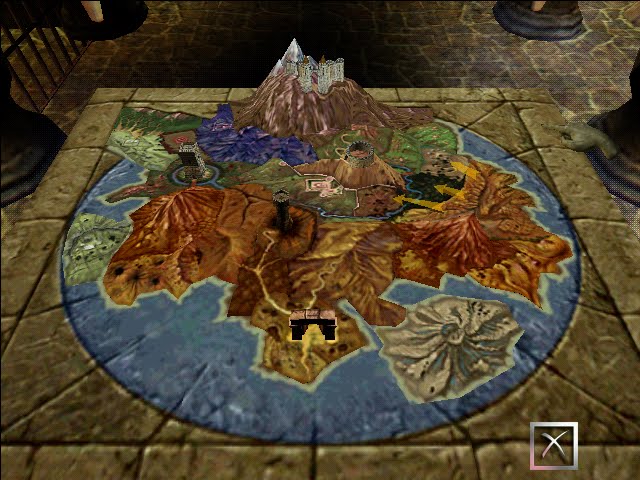
So what's the point? There must be more to life than lounging around in a luxurious underground fortress-casino surrounded by servants, treasure and leather-clad lovelies. Well, maybe. In the simple skirmish and multiplayer games, there are other keepers advancing towards you, and they must be defeated. But in the campaign game, it's the forces of humanity, moral rectitude, motherhood and apple pie that are trying to put a stop to your subterranean shenanigans. Those roving bands of heroes must be defended against while you bide your time and build forces strong enough to pursue them to their source and kill their lord so the Horned Demon can show up and claim that level's "portal gem". The keeper advances from land to land, undermining and doing battle with the resident heroes and collecting these gems. As each land is corrupted from beneath, it turns brown and withered on the campaign map - your progress is an advancing stain. All of this serves the ultimate aim of a final confrontation, in which the keeper burst forth onto the surface of an unsuspecting world ...

... Which never happens. Strangely, much of DK2 is just a set-up for a sequel, Dungeon Keeper 3, trailed within the game but cancelled early in 2000. Unless the franchise unexpectedly rises from its tomb, the keeper is condemned to toil within the bowels of the earth forever. It could be something from Milton or Dante. All that digging and undermining, only to find that you've just been getting deeper and deeper into the pit; perhaps a fitting fate for an evil overlord.