Showing posts with label my writing. Show all posts

Wednesday, 17 April 2013

Ink stuff

It's been a while. Sorry about that.

There are a fair few pieces by me on newsstands at the moment, although I'm afraid not many of them are available online. One prominent exception is my second piece for the New York Times, published on 23 March, probing the idea that a perfect home is the key to happiness, and tracing it back to modernist ideas about housing, health and hygiene. You might, if you have been kind enough to read it, of course recognise this as being an underlying preoccupation of Care of Wooden Floors.

Speaking of COWF, the German edition - Die nachhaltige Pflege von Holzböden, published by Carl's Books - is now on sale. Buy buy buy!

"The Anxiety of Influence" in Frame magazine issue 91, looks at copying and plagiarism in contemporary design and asks if too much emphasis is placed on novelty. Has fear of plagiarism led to "amnesiac design" that denies its own history and is disingenuous about its influences?

In Disegno issue 4 (S/S 2013) there's an essay by me examining press trips, a fundamental but little-remarked aspect of architecture and design discourse. Do they warp the way we see architecture and design? Are they, in fact, fundamentally corrupt?

I can be found in two places in Icon 119 (May 2013) - in the News section I talk to Sou Fujimoto about his plans for the Serpentine Pavilion, and the role of landscape in his architecture, and in Review there are my very positive thoughts about David E Nye's fascinating history of the assembly line.

A labour of love in the current issue of Art Review (#66, March 2013): reviewing the superb Extreme Metaphors: Interviews with JG Ballard 1967-2008.

In the spring edition of Audi magazine I mark the 40th anniversary of the first mobile phone call by talk to the man who made it, Martin Cooper.

Also now on sale is Metahaven's excellent essay Can Jokes Bring Down Governments? (Strelka Press), which is did not write but helped edit. It looks at the potential for anarchic viral online humour to overturn the present neoliberal austerity consensus, and the role of design and designers can play. Also it's witty and provocative, so please do take a look. 

Monday, 10 December 2012

Five Things I Didn't Know Until I Was Published

Thoughts after a year's adventures as a debut author, presented as a warning to other authors approaching publication.

1. Be careful what you write about your book. Long before publication, I had written a few short descriptions of my book - on this blog, in emails to my publisher, as a starting point for publicity materials, that sort of thing. I then spent a year watching those phrases getting spliced together, chopped apart and endlessly repeated. Stray bits of your phrasing end up on press releases, on the Amazon description of your book and elsewhere, and then get repeated back to you by bloggers and reviewers. That's the way of the world. But there was one turn of phrase I had used - it was my words describing my book - that I found trite and in-apt, and I kept seeing it everywhere, rebuking me for my own laziness for just tossing it off when I should have been more careful. So when writing a sentence describing your book, even in an ostensibly private email, consider how you'd feel having it read back to you as part of your introduction on stage at a literary festival.

2. Write your acknowledgments as late as possible. I wrote and filed mine really early, with the text of the book, and consequently neglected to include all sorts of people who should have been there. I later revised them but by then it was obvious what I was doing. Leave the acknowledgement to the last possible moment to minimise the risk of leaving people out.

3. Make yourself available. I have had nothing but good experiences with publicists. But all these lovely people seem to be haunted by previous bad experiences with authors. When I was asked to come and talk to a room full of booksellers about why they might be interested in reading and then prominently displaying my book, my answer was of course: "Why yes, naturally, what an amazing opportunity, thank you for setting it up, refusing would be tantamount to self-harm, I accept the invitation with frank gratitude!" However the invitation was proffered with a degree of trepidation, as if the answer is often: "What a monstrous waste of my time! Away with you!" And apparently there are authors who refuse all such opportunities. Which, as I say, strikes me as being tantamount to self-harm, and also a bit of a bum deal for the publisher who has taken you on. So I say, agree to whatever you can.

4. Appearances are harder than they look. I've been to see a lot of authors sitting on a stage in twos and threes, and I've often thought "that looks pretty easy". You sit there, a kindly moderator asks you helpful questions, everyone has a lovely time. I have a fairly pronounced fear of public speaking (although it has ebbed this year), so a chitchat panel or friendly interview always looked pretty good as a format. Well, I was wrong. First, they involve homework. If you're next to another author, it's only polite to read their books, for the audience's sake as much as for social nicety. So, depending on the number of authors you're appearing with and how many books they have written, you can have quite a large reading list and not very much time to cover it. It never occurred to me that literary festivals would involve so much reading. I thought they were what authors did instead of reading. Not that this is a bad thing, at all - it has exposed me to several good books I might never have otherwise picked up, for instance Francesca Kay's The Translation of the Bones and Iosi Havilio's Open Door. It was simply surprising, and I'm unused to having my fiction reading decided for me. Second - bloody hell, it's improvised. It might not be Paxman but you're still expected to come up with something reasonably cogent and, with any luck, interesting or entertaining to an audience at very short notice. Sometimes the mind just goes blank on the most basic things. This happened in the first radio interview I gave, and it was horrible. I was asked to explain how the narrator in Care of Wooden Floors gets from situation A to situation B and I just couldn't. I had forgotten the plot of my own book.

5. People have designs on your reading time. You get asked to read a lot of books, for comment or blurbing. And of course you can hardly say no, because only months before it was you or your editor out there tugging on the sleeve of other writers, who generously gave of their time. And now the wheel has turned, the bill is due. Free books, how awful, I know. Don't get me wrong - as with the literary festivals, this doesn't even qualify as work, especially when whatever you've been asked to read is incredibly good, as is the case with the novel I'm reading at present. However it does mean that your leisure reading time rapidly gets programmed - an injection of a modicum of duty into a private and intimate realm that can feel like quite a violation.


There are, of course, a lot more than five things I know now that I didn't know this time last year, but that's all for now. If I think of another five I'll post them.

Wednesday, 28 March 2012

Floorboards of Canada


Next week sees publication of the first overseas edition of Care of Wooden Floors, in the great nation of Canada! It's being published by the fine folks at Anchor Canada, part of Random House, and will officially go on sale on 3 April in paperback and ebook. The cover is almost identical to the British one, as you can see below. So, Canadian friends, buy, buy, buy! Please.

Friday, 23 March 2012

Floors on Tour, April: Oxford and Crystal Palace

I'm participating in two public events next month, so please come along if you can.

On Sunday 1 April at 10am I'll be at the Oxford Literary Festival, participating in a Writer's Round Table with Francesca Kay, author of the Orange-winning An Equal Stillness, and Romance Novel of the Year shortlistee Rachel Hore. We'll be discussing our own and each others' work, and "the joys and sorrows of writing fiction", so it promises a discussion of technique, coffee-making and how to avoid being distracted by the internet. I'm looking forward to getting some tips myself, especially on the last point. Or it could go another way entirely. Tickets are £10.

On Friday 13 April at 7.30pm I'll be at Bookseller Crow on the Hill in Crystal Palace, South London, in a reading with fellow debut novelists Lloyd Shepherd and Sophia Blackwell. There'll be readings from our respective books - Lloyd is the author of the gripping The English Monster, which I keep meaning to blog about, and Sophia first novel is called After My Own Heart - and some discussion, presumably on the subject of early adventures in publishing as that's where we're all at. This event is free.

Wednesday, 7 March 2012

Review: Ma Ligne


This is a review from Icon 100, October 2011. It wasn't put online as part of Icon's routine archiving so I'm posting it here.

“Mindless violence” is a concept that has been much aired in the media in the weeks after August’s riots in London and other UK cities. No doubt some violence really is mindless: spontaneous, purposeless, from nothing, to nowhere. The term was, however, mostly used as a declaration of lack of interest in the workings of the minds that engaged in a four-day carnival of theft and destruction on British streets. Thus the discussion can be sped along to retribution without any tiresome consideration of motive or causation. But violence and casual destruction deserve more attention than that. We can hardly do much about minimising them if we don’t examine them.

So we come to Ma Ligne. This is a curious little book, slim and highly seductive between grey suede covers neatly printed with the mysterious legend FUZI UV TPK. It is part art monograph, part police dossier: a catalogue of destruction. “Fuzi” is a French artist and, there’s really no point in being delicate about this, a vandal. Ma Ligne brings us five years of his work: his tag sprayed and scrawled over train carriages or cut into the fabric of the seats. Fuzi is not Banksy – he will not boost anyone’s house price and the council will not be listing his work. This is a loving tribute to routine vandalism. And seeing this kind of material degradation in a posh hardback edition of photographs gives us a crucial fraction of distance, which we can use to think about it without endorsing or condemning.

Fuzi’s medium and gallery was the St Lazare/Mantes la Jolie train line, which serves the western suburbs of Paris. The snapshots are mostly depopulated, giving them a melancholy, after-hours feeling. The only people who appear are members of Fuzi’s group, UV, Ultra Violent. The lack of audience is a necessity. This work takes place in moments of non-looking, inattention, when passengers, rail authorities and police are elsewhere. Once the act is complete, it is all about looking: catching attention, putting one’s name in front of people, claiming a space.

The accompanying texts (in French) give some background to this dedicated daubing, smashing and slashing. They’re a liberating read, even when you have to limp your way through with a dictionary, simply because Fuzi never really tries to justify his work. We don’t have to engage with an argument over why he’s right and our bourgeois notions are wrong. Instead what we get is a kind of love letter to the line, “My Line” (as the title says). “Elle était tout pour moi,” she was all for me, he writes tenderly. He enjoyed her every day, listening to the wheels, moving through her and around her in a state of perfect freedom, with rules or laws, “all-powerful”, writing his name on her skin. A career of vandalism becomes a passionate (and, clearly, abusive) love affair, with the police in the role of jealous husband. The poem Ode à la Destruction, one of two, layers a strong sexual vibe through the violence, “strong sensations, primitive”, with seats as “consenting victims”. Arrival at St Lazare seems cathartic. It’s troubling, haunting stuff, consciously provocative; certainly not mindless. Tags are more luminous after reading it, if no more attractive, justifiable or desirable.

Ma Ligne, FUZI UV TPK, Edition Patrick Frey, €46

Thursday, 23 February 2012

Ruins, asylums, fetishism, more of the usual

With the book launch* fun and excitement dying down I'll be making a return to more regular blogging shortly. Meanwhile here's a quick overview of new and forthcoming print journalism and other writing.


For starters I recommend the issue of Icon that's presently on newsstands. Icon 105 (March 2012) is devoted to Ruins and includes 2,000 words from me on Pripyat, the ghost city in the Chernobyl exclusion zone - this is of course based on my trip there with the Unknown Fields Division in July last year, and is also the first writing to appear from the Toxic Tourism project. More is on the way. There are also ruin-related pieces from my friends Douglas Murphy and Matt Tempest.

The issue also includes my review of William Gibson's collected essays, Distrust That Particular Flavor. Spoiler: I thought it was great.

(Douglas's piece is a riff from his book, The Architecture of Failure, which launches today. Buy buy buy!)

But be quick - at the end of next week Icon 106 (April 2012) will be out. It's a special issue devoted to the mobile phone, the most important object of our time, and includes a short piece by me on how mobiles have wreaked havoc in film and TV drama. There are a tonne of other pieces as well by writers including Will Self, Lee Rourke, James Bridle, Kieran Yates, Kazys Varnelis and many more. Plus a review by me of a new book about the Allende government's Cybersyn project. Spoiler: I thought it was great.

Back to longer pieces. I'm proud to be included in the first issue of Transgressive Culture, a new academic journal examining all aspects of transgression. There's a table of contents for issue 1 here - my contribution is an essay-length review of FUEL Publishing's book Dressing for Pleasure (link mildly NSFW), which looks back at vintage British fetish magazine AtomAge. Pick up a copy of TC if you can, there's some great stuff in it.

I'm also proud to be in the relaunched Architectural Review Australia - at the printers now and out shortly. The theme of issue AR124 is "Architecture and the Body" - my contribution looks at Victorian asylums, how their builders thought a good building could heal a troubled mind, and how that thinking later influenced the rise of the suburb.

And in case you missed it on Twitter, here's a piece I wrote for Untitled Books about "My Week".

Some more big chunks of writing coming soon.

* Did I mention I have a book out? In case you somehow missed my round-the-clock hawking of my novel, please go and buy it now.

Tuesday, 13 December 2011

Radio Floor


Image taken from the Flickr photostream of Sveeta Bogomolova and used under a Creative Commons Licence.

Exciting news! Care of Wooden Floors is being adapted for the radio. It will be Book at Bedtime on Radio 4 for two weeks, starting (I'm told) 30 January 6 February 30 January*. Naturally I'm delighted by this - it's a rare pleasure, in fact something like a dream come true, to have your work adapted for another medium and performed, and I can't wait to hear how it turns out. COWF - being largely the interior monologue of a man alone in a flat - has often seemed to me to be well suited to radio adaptation. So, please do tune in, or listen on iPlayer if you're unable to catch the scheduled broadcasts.

* UPDATE, 21 December 11: The broadcast will in fact start 30 January 2012, as originally stated, not 6 February - it changed, then it changed back. Sorry for any confusion and inconvenience. The story about the parental Christmas cards will be saved for the memoirs.

Tuesday, 22 November 2011

Letter I Never Sent

Last week I took part in Letters You Never Sent III: Letters to Corporations at Mason & Taylor in Shoreditch. We were asked to write to a corporation. Rather than complain about malfeasance or praise a product, I wanted to think of the most corporation-y corporation I could, one which I felt entirely neutral about. And when I tried to think of a generic, corporation-y corporation, I found one name lodged in my mind - and the fact it was lodged there was interesting to me.

To: Hutchison Whampoa
Hutchison House,
10 Harcourt Road,
Hong Kong

Dear Hutchison Whampoa,

Why you? Why write to you? It's the name, I think. In this country, I'm afraid to say, most people won't have heard of you. Even if they use the mobile phone network or pharmacy chain you own here, they will mostly believe they are customers of companies called 3 or Superdrug, not a corporation called Hutchison Whampoa. But that name, it works a kind of magic – it did for me, anyway. I can't remember when or where I first heard it, but I've always remembered it. Hutchison Whampoa. It's the perfect name for a corporation. There's the Hutchison. That's a name you can trust. Solid, Anglo-Saxon, Familiar. And then there's the Whampoa. Whampoa! What a beautiful word. Faraway, even exotic, but with confident, declarative edge. I assumed it was a person, the business partner to Mr Hutchison – that's a great strength of your name, it suggests an alliance between east and west, global scope, a Eurasian colossus. However Wikipedia tells me it's the archaic English transliteration of Huangpu, the dock area of the city of Guangzhou, a gateway for European trade to China from the 18th Century. All the better. That transnational, cyberpunky edge is given a romantic historical anchor.

Yes, Wikipedia – sorry about that. As I say, you're an enigma, Hutchison Whampoa. I knew your name, but that doesn't reveal anything about what you do. That's the other great strength of the name – it's abstract, it doesn't point the mind in any particular direction, you could be be doing anything anywhere. Everywhere, in fact. That mobile phone company you own – you don't own the phones themselves. You own an infrastructure or transmitting masts, but even that's not the most important part of the business – you own a section of electromagnetic spectrum, a slice of bandwidth, a portion of the air itself. The masts are just a way of modulating your ethereal empire, making it accessible, packaging morsels of it for sale. Owning part of the air – that's ubiquity, that's proper corporate reach. And you own a chain of cut-price perfume shops, too: owning the air, the technology to broadcast across it and the means to scent it. That's comprehensive service.

Maybe you should buy a kite factory, and cover that atmospheric niche too. Maybe you already own one – is there anything you don't do? You say you have five core businesses – I like that, core businesses, one day you must tell me about all your less important flesh and pith businesses. Five core businesses, then. There's ports and related services – nice to see you're still keeping your hand in. And there's retail; telecoms; property and hotels; and my favourite, energy, infrastructure, investments and others. Are you sure that last one is just one business, because it sounds like at least three. “And others.” So modest, Hutchison Whampoa.

I hope you're not sensitive about your size – you're a $42 billion dollar corporation, have a bit of confidence. Don't infer any criticism. I like the polymathic generosity of your endeavours. It feels properly corporate – the sum of many efforts. Forgive my intrusion. Can you forgive? I am sure you can forget. Corporations are good at forgetting, and unseeing, and not being seen, and moving on. You are not your holdings. You own, you operate, you merge and demerge. It's tempting to think of you as the apex of a pyramid, but you're less substantial and more far-reaching than that. You are a grand transaction, one that has been in process for centuries, a current, a trade wind. Even surrounded by you, we don't see you. I thought you might like to be noticed, Hutchison Whampoa, this once.

Cordially, etc.

Wednesday, 17 August 2011

Make Room! Make Room!

My piece on the hellish "rodent universes" of John Calhoun is now online at Cabinet magazine. Researching overcrowding, Calhoun built elaborate "utopias" for rats and mice, in which they enjoyed unlimited resources and freedom from disease or predation - but limited space. Once population density passed a certain point, the mouse heaven always became mouse hell, rife with violence, rape and asocial freakery. This research formed a cornerstone of the overpopulation and anti-urban doom-mongering of the 1970s - and informed fictions from Stand on Zanzibar to Soylent Green.

Here's Calhoun in one of his universes, via Wikimedia:

Friday, 12 August 2011

Space out


My New Statesman review of "Out of This World" at the British Library, which I mentioned earlier, is now online.

Here's an idea for a science-fiction story. Humanity suffers a recurring bout of cultural amnesia. Bearers of the flame must restate the same ideas, and refute the same myths, every ten or 20 years. But, twist! This isn't some distant future but our own time. Such is the cultural Groundhog Day that afflicts science fiction. The genre contains much serious literature, and much serious literature should be considered part of the genre. The ghetto walls may be weaker than ever but the case still has to be made over and over again.

Read the rest.

Friday, 5 August 2011

Aliens! Fetishists! Situationists! Psychopathic mice!

There's a bumper crop of stuff by me floating around in August, on a pleasingly wide array of subjects.

In this week's New Statesman (edition of 8 August) I review "Out of This World", the British Library's survey of science fiction ephemera - an exhibition well worth catching before it finishes on 25 September.

On the chunkier side, there are a hat trick of longer, thinkier essays approaching the newsstands. I'm in the first issue of new journal Transgressive Culture, published by Glyphi, reviewing Jonny Trunk's Dressing for Pleasure (FUEL), a compilation of classic fetish magazine AtomAge. I first reviewed Dressing for Pleasure last year for Icon - this is a much more in-depth look at the book, attempting to place it in a cultural context.

In issue 42 of American art quarterly Cabinet, there's an essay by me on the American ecologist John Calhoun. Calhoun was interested in the effects of overcrowding, a phenomenon he explored by building elaborate "utopias" for mice and rats. These "universes" were free of disease and predators and supplied with abundant food and water - all they lacked was space. Rodent populations inside the tanks boomed uncontrollably - and then collapsed into a vortex of rape, violence and social dysfunction. Enthusiastically taken up by the overpopulation doom-mongers of the 1960s and 1970s, Calhoun's research became the "proof" that crowded cities would mean disaster for mankind - but Calhoun's message is a little more complex than that.

More, better, utopias. Under/Current issue 06 has the theme "retro-future", a chance for me to talk about my favohttp://www.blogger.com/img/blank.gifurite world-that-never-was, Constant's New Babylon. The trouble with utopias is that they tend to be striving, efficiency-minded places. New Babylon was a reaction against that - a paradise for slackers, a world-spanning megastructure geared to wandering, idling and socialising.

And finally - Icon 099 is now on sale, featuring eight pages by me on one of the most exciting design studios in London, BERG. A conversation with BERG is like hearing a friend tell you about a brilliant concept from a science-fiction novel they just read. Only they didn't just read it, they're trying to build it. And look, here's a prototype. They're an interesting bunch, to say the least.

Saturday, 30 July 2011

Found satire

Accidental News of the World commentary, from Care of Wooden Floors, page 94:
Brooks ran in the gutters, seeking lower elevations.

Tuesday, 12 July 2011

Away


The Unknown Fields expedition just touched down in Kiev. I expect to be mostly offline for the next couple of weeks, so don't expect speedy responses to emails, but I'll tweet, add pictures to Flickr and perhaps even blog as and when I can. See you on the other side.

Wednesday, 6 July 2011

3 ... 2 ... 1 ... Launch


The Unknown Fields expedition to Chernobyl and Baikonur - fulcrum of my promised book Toxic Tourism - is steadily clearing its no/no-go checks and trundling towards the launchpad. The official launch will be on Monday with a frankly blockbusting public forum at the AA on Bedford Square, London. The line-up is simply incredible, extending beyond the participants in the expedition to include everyone from artist Paul Duffield to UFO folklorist Mark Pilkington - plus poets, sound artists, filmmakers, it really promises to be a really fascinating day. (Liam Young, Unknown Fields co-mastermind with Kate Davies, is also the creator of Thrilling Wonder Stories, so he knows how to put on an amazing day-long event.)

I'm also in the line-up, introducing my work and talking a little about my intentions and aspirations for Toxic Tourism. To give you a taster, I will be dealing with the lure of forbidden places and wildernesses, why places like Chernobyl, Aral and Baikonur tug at the imagination, and the ultimate in getting away from it all: excursions into a posthuman, postapocalyptic world.

So, please come along.

The photo at the top of this post shows the AA's 2009 summer pavilion, and is from my Flickr photostream.

Thursday, 23 June 2011

Flaw plan


Care of Wooden Floors is set in an apartment in an inter-war moderne block in an unnamed central-European city. During the writing of the book, I made a number of sketch plans of the apartment, the block and the surrounding streets as aids to memory or to work through specific narrative problems. Later, as I discussed the design of the book with Clare Smith, my editor at HarperPress, the idea arose that we could use one of these floor plans as an endpaper for the book in hardback.

I was enthusiastic. When I was a child, I had a weakness for fantasy novels - and gravitated towards those that had a map at the front. Tolkien must have started this tendency with his beautiful maps of Middle Earth in The Hobbit and the Lord of the Rings trilogy. A map at the front of a fantasy book worked as a kind of blurb, a promise of the adventures to come - you just knew that the mountain-ringed forbidden city or the skull-shaped island fortress jutting from a wreck-garnished sea was going to crop up somewhere. It would be a hell of a tease if they didn't. Moreover, the map is part of the escapist promise of fantasy: that you are entering a fully realised world, one that extends beyond the bounds of the story, and that even if the stinging deserts and haunted swamps are barely alluded to, they they can exist more fully in your own imaginative rendering of the world. Nowadays, my map fix comes primarily for nonfiction books of history - Amanda Foreman's A World on Fire, which I'm steadily gnawing my way through at the moment, has a fine selection throughout its 900 pages. The only work of non-fantasy literary fiction I can think of with a map at the front is Toby Litt's Deadkidsongs, although I think there must be others.

Care of Wooden Floors isn't a fantasy, but I liked the idea of a map as a tribute to those happy memories of childhood reading - and also as an expression of the rational interior-design ambitions of Oskar, the flat's owner. But I asked to re-draw the master sketch map for inclusion, to iron out some small inconsistencies in it here an there and to ensure that it was the most accurate possible rendition of the flat.

Almost immediately, I ran into problems. I already knew that the master floorplan didn't match up with my mental picture of the flat, and the way it was described in the book. That was why I wanted to redraw it. But attempts to iron out the difficulties simply created new problems. In effect, I could not draw a floorplan of the flat - it was an impossibility.

This doesn't mean that there's a mistake in the book, or that an impossible or impractical configuration of rooms is described. Although the flat is, over the course of 300 pages, described in some detail, it's not empirically described. The book isn't a blueprint. I didn't give measurements, proportions and orientations of every aspect of the building. A reader could sketch an entirely reasonable floorplan of the flat without having to resort to extra dimensions or folds in spacetime. But I'm fairly sure it wouldn't match up with mine.

What I was dealing with is three different versions of the same flat:

1. The flat as it exists in my imagination
2. The flat as described in the book
3. The flat as it might exist in the imagination of the reader.

Version 2 is based on version 1; version 3 is based on version 2. It made most sense to base a floorplan on version 2, to avoid "error". But when I looked at the result, a prominent detail failed to match my mental picture of Oskar's home. This detail is irrelevant to the plot or to anyone's understanding of the book; and it isn't described in the book, it is simply the result of reconciling two aspects of layout that might otherwise conflict. But it troubled me to commit to graph paper something that was "untrue". Fixing it threatened to raise more problems than it solved.

We decided not to include a floorplan. My own reservations were only part of this decision - it was also considered too dry a note to open on, and potentially distracting to a reader. I would much rather a reader builds up their own image of the flat from the words, rather than being guided down to exact details by a plan. But the episode has caused me to realise the protean nature of what I've written. Which is the "true" flat? All three versions are, in their way, but I have to confront the fact that my mental picture of the flat is now the least important of those versions, and the reader's version is the most important.

Thinking on about maps in fiction, I remembered (from reading Martin Amis' criticism, I think) that Nabokov drew maps of great books to illustrate his lectures on English literature. Here's Nabokov's map of Stephen and Bloom's routes around Dublin in Joyce's Ulysses:


Nabokov recommended that instructors draw up diagrams the setting of books to wring the maximum amount of sensual detail from them, as a route to fuller understanding of the author's intentions. It's only what is described that matters; writing is in part a matter of choosing what to describe and what not to describe. A detail that existed in my conception, but which is not described at all, cannot be said to matter at all. To suggest it in a floorplan when it doesn't exist in the text would sprain the imaginative sinews that any reader spins around the descriptive bones the author provides. That would hardly be fair or desirable.

(The hunt for Nabokov's Dublin map led me to this rather wonderful project, a detailed, annotated Google map of Dublin overlaid with a historic map.)

Tuesday, 14 June 2011

A Cover for COWF

Care of Wooden Floors now has a cover:


I'm hugely pleased with this. It was designed by Jo Walker at HarperPress, and I was fortunate enough to be allowed along for part of the process, making up the lettering in Mr Smith's letterpress workshop.


Making up the type.


The type on a galley, about to be transferred to the press. All these years in magazine journalism we've talked about "galleys" meaning proofs that haven't yet been laid out, but this is a galley in the original sense - a metal tray for carrying type.


Making an impression from the type.


Spot the deliberate mistake. It's actually pretty hard to proofread when everything is upside-down and backwards.


Jo inspecting her handiwork. Thanks, Jo!

There's a full set of images up on my Flickr stream, and some videos were made of the process - hopefully those will be online soon too.

Wednesday, 8 June 2011

Announcing "Toxic Tourism"

It's in The Bookseller, so at last I can start talking about the second book! Provisionally titled "Toxic Tourism", it will be an unconventional travel guide to three places in the former Soviet Union: the Chernobyl Exclusion Zone, the Baikonur Cosmodrome and the Aral Sea. The publisher will be HarperPress, who of course is also publishing Care of Wooden Floors. Toxic Tourism will be out a few months after 2012.

This is under the umbrella of the Unknown Fields trip in July (which makes the Bookseller's use of the past tense a little puzzling). I'm hugely grateful to the AA's Liam Young, who put out a call for a writer to accompany the trip at the beginning of May, to Robin Harvie and Clare Smith at Harper Collins, and to my agent Antony Topping. So, exciting times afoot. I'll fill in some more details later.

Saturday, 4 June 2011

The Latest Hallucinations


I've been up to my neck in "proper writing" and neglecting the blog lately. So this is one of those somewhat unsatisfying "read me elsewhere" posts - made extra unsatisfying by the fact that a lot of this stuff isn't online.

One thing that is online is this review of a small show in Eindhoven called "The New Psychedelica". The show really scratches an itch for those of us who feel that art hasn't really plumbed to depths of weirdness offered by the digital world.

Also online is this review of Locals Only, a photographic record of California's 1970s skate culture, at men's style website Jock & Nerds.

The new issue of Icon has a long piece by me mulling what London's new crop of skyscrapers means for the city, in the company of sculptor, polymath and expert Londoner Richard Wentworth. There's also a much shorter piece by me about David Chipperfield's Hepworth Wakefield.

Print-only (for the time being) but free is The Clerkenwell Post, an attractive zine about all things Clerkenwell. It was produced by Icon's publisher and launched at Clerkenwell Design Week. If you're in the area copies can still be found - there's a piece in there by me about the Barbican.

Pretty soon there'll be a flurry of news about the novel, now a mere eight months away from publication. Only eight months! It seems like just six months ago it was fourteen months away from publication. But here's something: you can pre-order it on Amazon now.

Next week there will (I hope) be some news about the Secret Project which has been eating up a lot of my time behind the scenes.

And I will be doing more blogging soon.

Wednesday, 20 April 2011

Theme Necropolis

This article originally appeared in Edge 221 (December 2010).


The sound of digging pervades Dungeon Keeper 2. Bullfrog's 1999 real-time strategy game involves the construction and operation of a dungeon and labyrinth in a gloomy underground world. There are always chambers to be excavated, minerals to be mined and exploratory tunnels to be dug in order to expand your area of play. The imps, tiny magical creatures that comprise your basic workforce, are continually scraping and picking away at the ground somewhere at your bidding. It's a pleasantly double-edged sound – industrious, but also subversive. You're eating away at the world around you, undermining, corroding, tunnelling like a colony of termites. And if your imps run out of orders and stop working – you'll see them sit against the wall and light up cigarettes – you might still hear digging. That would be the sound of one of your rival keepers chipping away at the rock in your direction, heading inexorably towards you.

Building and undermining at the same time – that's the centre of the appeal of Dungeon Keeper 2 (DK2). The player must design and construct a detailed and multi-functional underground world to perform a number of tasks, but also revel in destruction, murder, torture and slavery. Indeed, those are the tasks. This is a dungeon, after all. In other hands, DK2 could have been a recipe for dreary sadism. But Bullfrog put together a world that was all about beautiful, rich, detailed, absorbing, funny sadism.

A typical game begins with a single chamber: the Dungeon Heart. This, the core of your realm, is where your treasure is stored and is also the source of your health. If the gigantic pulsing muscle (you heard me) at the centre of this room is subjected to a sustained attack by your enemies, it will die, and if it dies, you die. So the dungeon must be built up around it: rings of defences, and facilities that will attract and sustain an army of happy, belligerent monsters. These start with a lair, which gives them somewhere to sleep, a hatchery, which provides chickens for them to eat, and a training room for them to hone their combat skills. Specialist structures like libraries, workshops and torture chambers attract specific kinds of monsters, although most of the creatures in DK2 are familiar Sword & Sorcery types. Later, swankier rooms include glamorous casinos and not-so-glamorous combat pits, which either make creatures happier by giving them R&R or make them better killers by sending them to A&E. Some of them also seem to enjoy recreation in the torture chamber, but we're not here to judge. And there's the digging – always with the digging. Chambers and tunnels must be excavated and gold must be found and mined. Pick, scrape, shovel, etcetera.


Laying out rooms and corridors, assigning functions to them, attracting employees and specialists … At this point, a particular strain may be identified in DK2's twisted DNA: it is obviously a descendant of Bullfrog's Theme Hospital, which was developed in parallel with the original Dungeon Keeper and released just months before it in 1997. So where are the patients? In Theme Hospital, the aim was to keep the members of the public who strayed into your world alive, and they mostly only died by accident. Mostly. In DK2, the roaming members of the public are tedious, bellowing heroes, representatives of the so-called forces of good, and if they find their way into your realm they need to be subjected to a deadly form of triage. Your troll-filled workshops can build traps, from simple passive defences like doors to the all-time classic: a rolling Indiana Jones-style boulder that can crush everything in its path. In between are all kinds of dangling skeletons and poison gas vents. Many happy hours can be spent ringing your lair with fiendish killing-chambers, hidden triggers and secret passages. Softened up by the traps, surviving heroes can be set upon by your creatures and beaten to within an inch of their life. Enemies are mostly just stunned if they lose a fight – while thus poleaxed, they can be dragged to a prison. There, they will either starve and rise as a skeleton to join your armies, or they can be dropped in a torture chamber, where they'll be tormented by whip-wielding dominatrices called Mistresses (a saucy element the game revels in) and become allies. Your own creatures can, when stunned, be dragged back to the lair to recover. If the imps are too late and the creature dies, they can be dragged to a graveyard and buried, later to rise as a vampire. It's Theme Necropolis.

The original Peter Molyneux-designed Dungeon Keeper had a similarly detailed internal ecology and other charms, but doesn't often come out of its box nowadays, while DK2 continues to be a treat. It's rare that a sequel can lose a talent like Molyneux and still exceed its ancestor, but Bullfrog's Colin Robinson managed it. DK2 is a vast graphical advance on the original, substituting fully 3D creatures for sprites and introducing a depth and richness to the interiors that is truly atmospheric. The player interacts with this gorgeous environment via a disembodied hand – a feature carried over from the original, which Molyneux was to re-use in Black & White (2001). The hand allows a much deeper tactile involvement in the game environment than a simple cursor. Not only can creatures and gold be picked up, encouraging slaps can be dispensed – including animals you first think are just decorative, like the chickens in the hatchery and the rats in the prison. DK2 is also far funnier than the original, with a jokey narration by Richard Ridings (see box) and a seemingly inexhaustible supply of in-game jokes and Easter eggs. Humour was a strand of Dungeon Keeper – it's at the malevolent heart of DK2. That might be its real advantage over the original game. Molyneux's original game was part of his career-long interest in bending and manipulating morality within games, from Populous (1989) to Fable (2005). 2001's Black & White, which made choosing between good and evil the central dilemma of an RTS game, could be considered the lost sequel to DK2. But what makes DK2 really refreshing is that it's less self-conscious about its immorality than its predecessor – it's just raucous good fun.


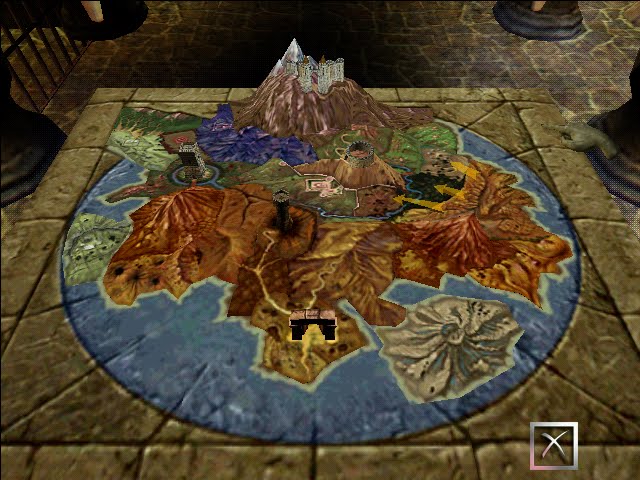
So what's the point? There must be more to life than lounging around in a luxurious underground fortress-casino surrounded by servants, treasure and leather-clad lovelies. Well, maybe. In the simple skirmish and multiplayer games, there are other keepers advancing towards you, and they must be defeated. But in the campaign game, it's the forces of humanity, moral rectitude, motherhood and apple pie that are trying to put a stop to your subterranean shenanigans. Those roving bands of heroes must be defended against while you bide your time and build forces strong enough to pursue them to their source and kill their lord so the Horned Demon can show up and claim that level's "portal gem". The keeper advances from land to land, undermining and doing battle with the resident heroes and collecting these gems. As each land is corrupted from beneath, it turns brown and withered on the campaign map - your progress is an advancing stain. All of this serves the ultimate aim of a final confrontation, in which the keeper burst forth onto the surface of an unsuspecting world ...

... Which never happens. Strangely, much of DK2 is just a set-up for a sequel, Dungeon Keeper 3, trailed within the game but cancelled early in 2000. Unless the franchise unexpectedly rises from its tomb, the keeper is condemned to toil within the bowels of the earth forever. It could be something from Milton or Dante. All that digging and undermining, only to find that you've just been getting deeper and deeper into the pit; perhaps a fitting fate for an evil overlord.

Saturday, 2 April 2011

Playing in the Ruins


Bronx Floors, Gordon Matta-Clark

My New Statesman piece about Pioneers of the Downtown Scene at the Barbican, mentioned below, is now online. "The sense of decay and collapse pervades this show," I say. That's a good thing.